• A
  • A
  • A
  • АБВ
  • АБВ
  • АБВ
  • A
  • A
  • A
  • A
  • A
Обычная версия сайта
  • RU
  • EN
  • HSE University
  • Publications
  • Book chapter
  • Chapter 19 - Holocene glacier variations in the Northern Caucasus, Russia
  • RU
  • EN
Расширенный поиск
Высшая школа экономики
Национальный исследовательский университет
Priority areas
  • business informatics
  • economics
  • engineering science
  • humanitarian
  • IT and mathematics
  • law
  • management
  • mathematics
  • sociology
  • state and public administration
by year
  • 2027
  • 2026
  • 2025
  • 2024
  • 2023
  • 2022
  • 2021
  • 2020
  • 2019
  • 2018
  • 2017
  • 2016
  • 2015
  • 2014
  • 2013
  • 2012
  • 2011
  • 2010
  • 2009
  • 2008
  • 2007
  • 2006
  • 2005
  • 2004
  • 2003
  • 2002
  • 2001
  • 2000
  • 1999
  • 1998
  • 1997
  • 1996
  • 1995
  • 1994
  • 1993
  • 1992
  • 1991
  • 1990
  • 1989
  • 1988
  • 1987
  • 1986
  • 1985
  • 1984
  • 1983
  • 1982
  • 1981
  • 1980
  • 1979
  • 1978
  • 1977
  • 1976
  • 1975
  • 1974
  • 1973
  • 1972
  • 1971
  • 1970
  • 1969
  • 1968
  • 1967
  • 1966
  • 1965
  • 1964
  • 1963
  • 1958
  • More
Subject
News
July 16, 2026
Team Success: Aligning Means with Objectives
In corporations, sports, and academia, people often face challenges they cannot handle alone. In such cases, selecting the right team is crucial. Tatiana Mayskaya, Associate Professor at the HSE Faculty of Economic Sciences and the International College of Economics and Finance, together with colleagues from foreign universities, examined team characteristics and found that less diverse teams are better suited to objectives where a high average performance is important, whereas more diverse teams are preferable when avoiding failure is critical. The paper has been published in Economic Theory.
July 15, 2026
Economists Propose More Effective Approach to Reducing Smoking
Economists at HSE University have examined how smokers respond to changes in cigarette prices. When tobacco prices increase, cigarette consumption does not always decline. In fact, spending on tobacco may even rise: according to the researchers, a 1% decrease in cigarette affordability leads to a 0.28% increase in per capita tobacco expenditure. The findings suggest that to reduce smoking rates, tobacco prices must rise faster than household incomes. The study has been published in Voprosy Statistiki.
July 15, 2026
HSE MIEM Students to Develop Two Satellites from Scratch for Orbital Experiments
The devices, created by student teams, will conduct space research on the properties of promising solar cells, on-board energy storage systems, and serial electronics for student satellites.


Have you spotted a typo?
Highlight it, click Ctrl+Enter and send us a message. Thank you for your help!

Publications
  • Books
  • Articles
  • Chapters of books
  • Working papers
  • Report a publication
  • Research at HSE

?

Chapter 19 - Holocene glacier variations in the Northern Caucasus, Russia

Ch. 19. P. 353–365.
Solomina O., Jomelli V., Irina S. Bushueva

More than 1500 glaciers exist on the northern (European) side of the Greater Caucasus. Until recent times, the ages of the Holocene moraines in the Caucasus were based on fragmented information (14C, historical, tree-ring and lichenometry data) that mainly covered the Late Holocene. Available 10Be dates of moraines are still very limited in number and are not well replicated. However, even these very preliminary data have allowed for the first time identification of the age of some Holocene moraines in Caucasus at the glaciers Alibek (western Caucasus), Greater Azau, Irik, Schkelda, Terskol, Kashkatash, Donguz-Orun (Elbrus area, central Caucasus) and Bezengi (Cherek Bezengiisky valley, central Caucasus). According to these 10Be age estimates, the glacier advances occurred at c. 10.9, 7.0–6.6.6, 3.0–2.9, 1.6, 0.7–0.8, 0.5, 0.25 and 0.16–0.14 ka. The Early Holocene advance is documented in one valley (Terskol) and the date needs confirmation. Surprisingly, we identified a possible prominent advance of Bezengi Glacier in the warm period at c. 6 ka. The moraines yielding 10Be ages younger than 1.6 ka in the Elbrus region usually represent a compound complex consisting of several ridges that directly contact the moraines of the LIA maximum. The 10Be dates of the two advances at 2.9 ka and CE 1840s–1860s are supported by the other independent geochronological and stratigraphic data (14C dates of palaeosols at Greater Azau Glacier). The younger glacier maximum is also confirmed by historical and tree-ring data (CE 1840s). Since the middle of 19th century, the glaciers in the Caucasus are retreating.

Language: English
DOI
Text on another site
Keywords: HoloceneGlacier variations

In book

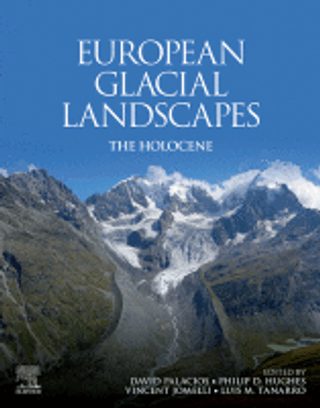
European Glacial Landscapes
Solomina O., Jomelli V., Charton J., Schimmelpfennig I. Elsevier, 2024.
Similar publications
First description of a mummified Middle Holocene brown bear from the New Siberian Islands, Russia
Nedoluzhko A., Slobodova N., Ursus 2024 Vol. 35e10 P. 1–12
The brown bear (Ursus arctos L., 1758) is a widespread bear species inhabiting the forest zone of Eurasia, including the Republic of Yakutia. The association with forest habitats explains why the Pleistocene findings of U. arctos fossils are rare in the northern part of Eastern Siberia, where open steppe-tundra and steppefied landscapes prevailed during the Pleistocene. Fossils of U. ...
Added: March 25, 2026
New Data on the Stratigraphic Significance of the Cheremoshnik Section (Yaroslavl Oblast)
Sheremetskaya E. D., Karevskaya I. A., Samus’ A. V. et al., Moscow University Geology Bulletin  2024 Vol. 79 No. S1 P. S100–S109
For decades the northeastern slope of the Borisoglebsk Upland has been a focal point for natural scientists interested in geochronology and Quaternary environmental reconstructions. A key reference section of the Upper Volga River region is a set of geological cores, exposures and excavations on the sides of the Puzhbol Gully system. The ORV section (Eastern ...
Added: March 21, 2026
Quantitative pollen-based reconstructions of climate characteristics and forest coverage for Northern Central Siberia: evaluation of different techniques
Andreev R., Novenko E., Quaternary International 2025 No. 739 Article 109879
The paper presents the application of four quantitative methods for pollen-based palaeoclimatic reconstruction (the Best Modern Analogue technique (MAT), weighted averaging (WA) and weighted averaging partial least squares (WAPLS) transfer functions and Random Forest algorithm (RF)) to derive temperatures, precipitation and total woody coverage (in 5, 10, 20 and 50 km radii) for the poorly ...
Added: February 16, 2026
First description of a mummified Middle Holocene brown bear from the New Siberian Islands, Russia
Cheprasov M., Boeskorov G., Novgorodov G. et al., Ursus 2024 Vol. 2024 No. 35e10 P. 1–12
The brown bear (Ursus arctos L., 1758) is a widespread bear species inhabiting the forest zone of Eurasia, including the Republic of Yakutia. The association with forest habitats explains why the Pleistocene findings of U. arctos fossils are rare in the northern part of Eastern Siberia, where open steppe-tundra and steppefied landscapes prevailed during the Pleistocene. Fossils of U. ...
Added: April 3, 2025
Новые данные о стратиграфической значимости разреза «Черемошник» (Ярославская область)
Шеремецкая Е. Д., Каревская И. А., Самусь А. В. et al., Вестник Московского университета. Серия 5: География 2022 № 4 С. 88–100
For several decades the northeastern slope of the Borisoglebsk Upland has been a focal point for natural scientist interested in geochronology and Quaternary environmental reconstructions. A key reference section of the Upper Volga River region is a set of geological cores, exposures and excavations on the side slopes of the Puzhbol Gully system. The ORV ...
Added: October 5, 2024
The mid- and late Holocene palsa palaeoecology and hydroclimatic changes in Yenisei Siberia revealed by a high-resolution peat archive
Novenko E., Prokushkin A., Mazei N. et al., Quaternary International 2024 No. 682 P. 8–21
The paper presents a new high-resolution (up to decadal) palaeoecological evidence based on detailed AMS radiocarbon dating, plant macrofossils, testate amoebae, loss on ignition, peat humification, elemental and stableisotopic records, obtained from a palsa peatland located in vicinities of Igarka town. This gave us a unique possibility to examine the mid-to late Holocene environmental changes ...
Added: February 21, 2024
A 1300-year multi-proxy palaeoecological record from the northwest Putorana Plateau (Russian Subarctic): environmental changes, vegetation dynamics and fire history
Elena Yu. Novenko, Mazei N., Dmitry A. Kupriyanov et al., The Holocene 2023 Vol. 33 No. 2 P. 181–193
This paper presents a reconstruction of natural environmental dynamics, wildfires and vegetation change in northwest Putorana Plateau during the last 1300 years. The study area is a remote and poorly investigated region of subarctic Siberia, relatively untouched by human impacts, which offers a unique opportunity to examine natural environmental dynamics and climate-vegetation-fire relationships. The paleoenvironmental reconstructions ...
Added: February 20, 2024
Chapter 10 - Holocene glacial landscapes of the Russian Arctic and the Urals
Solomina O., Irina S. Bushueva, Glazovsky A., , in: European Glacial Landscapes.: Elsevier, 2024. P. 149–169.
There is a paucity of glacial geologic and palaeoclimatic evidence for the reconstruction of Holocene glacier and climate history in the Polar Urals (PU), Novaya Zemlya (NZ) and Franz Josef Land (FJL). Moreover, the three regions are very different in terms of climate and glacial morphology. For these regions, only very preliminary conclusions on Holocene ...
Added: January 24, 2024
European Glacial Landscapes
Solomina O., Jomelli V., Charton J. et al., Elsevier, 2024.
This chapter reviews previous studies that have been carried out on the synthesis of European glaciated landscapes during the Holocene. Although these studies are scarce, they are useful to understand the context and state of the art. The analysis reveals three distinct periods of research activity, the first one that covered the 18th, 19th, and ...
Added: January 24, 2024
In Search of the Elusive North: Evolutionary History of the Arctic Fox (Vulpes lagopus) in the Palearctic from the Late Pleistocene to the Recent Inferred from Mitogenomic Data
Panitsina V., Bodrov S., Boulygina E. et al., Biology 2023 Vol. 12 No. 12 Article 1557
Global warming at the border of Late Pleistocene-Holocene, around ten thousand years ago caused a dramatic rearrangement of habitats in the Northern Hemisphere. Populations of cold-adapted megafauna species, which were spread over large areas of Eurasia, did not survive it. At the same time, small representatives of this mammoth fauna complex survived, including lemmings and ...
Added: November 17, 2023
Ancient DNA of the Don-Hares Assumes the Existence of Two Distinct Mitochondrial Clades in Northeast Asia
Sharko F., Slobodova N., Boulygina E. et al., Genes 2023 Vol. 14 No. 3 Article 700
Paleoclimatic changes during the Pleistocene–Holocene transition is suggested as a main factor that led to species extinction, including the woolly mammoth (Mammuthus primigenius), Steller’s sea cow (Hydrodamalis gigas) and the Don-hare (Lepus tanaiticus). These species inhabited the territory of Eurasia during the Holocene, but eventually went extinct. The Don-hare is an extinct species of the ...
Added: September 20, 2023
Soils at archaeological monuments of the Bronze Age – a key to the Holocene landscape dynamics in the broadleaf forest area of the Russian Plain
Makeev A., Rusakov A., Kurbanova F. et al., Quaternary International 2021 Vol. 590 P. 26–47
During the second half of the Holocene, the Russian Plain experienced several climatic oscillations giving rise to changing vegetation patterns. The spatial variability of vegetation changes and its effects on soils is still a matter of debate. In the present study landscape response to Holocene climatic cycles was analysed on the base of detailed morphological, ...
Added: February 27, 2023
Pedogenic response to Holocene landscape evolution in the forest-steppe zone of the Russian Plain
Kurbanova F., Makeev A., Aseyeva E. et al., Catena 2023 Vol. 220 Article 106675
Soils buried under five defensive ramparts of the Early Iron and Middle Ages were studied in the forest-steppe zone of the Russian Plain (Lipetsk region, Russia). The time of the burial differs from each other for hundred years allowing studying variation of soil properties based on short-term chronosequences within these ranges and reconstructing the comparatively ...
Added: February 27, 2023
Ancient DNA Reveals Maternal Philopatry of the Northeast Eurasian Brown Bear (Ursus arctos) Population during the Holocene
Boulygina E. S., Sharko F. S., Cheprasov M. et al., Genes 2022 Vol. 13 No. 11 Article 1961
Significant palaeoecological and paleoclimatic changes that took place during Late Pleistocene—Early Holocene transition are considered important factors that led to megafauna extinctions. Unlike many other species, the brown bear (Ursus arctos) has survived this geological time. Despite the fact that several mitochondrial DNA clades of brown bears became extinct at the end of the Pleistocene, ...
Added: January 30, 2023
The Riverine Past of Lake Seliger
Konstantinov E. A., Panin A. V., Karpukhina N. V. et al., Water Resources 2021 Vol. 48 No. 5 P. 635–645
Lake Seliger has been always classified as a former glacial water body, a remnant of a vast proglacial lake, which has existed since the disappearance of the last glacial Ice Sheet in the territory 18–19 thousand years ago. The study was focused on areas of southern pools of the lake looking like underflooded meandering river ...
Added: October 28, 2022
Peatland initiation in central european russia during the holocene: Effect of climate conditions and fires
Novenko E., Mazei N. G., Kupriyanov D. et al., The Holocene 2020 Vol. 31 No. 4 P. 545–555
Peatlands store massive amounts of organic carbon, but the fate of this carbon remains unclear as global climate continues to warm. The age of peatland inception and the main drivers of peat initiation are one of the most important issues in Holocene paleoecology, especially for the numerous but under investigated peatlands in European Russia. This ...
Added: October 11, 2021
Реконструкция динамики лесных пожаров Центральной Мещеры в голоцене (по данным палеоантракологического анализа
Куприянов Д. А., Novenko E., Сибирский экологический журнал 2019 С. 253–263
Представлена реконструкция динамики лесных пожаров и их влияния на растительный покров цен- тральной части Мещерской низменности в голоцене, выполненная по результатам изучения свойств тор- фяной залежи болота Студенческое: концентрации макроскопических частиц угля, спорово-пыльцевого анализа и радиоуглеродного датирования. Согласно полученным данным, в период высокой интенсивности лесных пожаров ~9200 – 6400 календарных лет назад (кал. л. н.) ...
Added: October 11, 2021
Widespread drying of European peatlands in recent centuries
Swindles G., Novenko Elena, Warner B., Nature Geoscience 2019 No. 12 P. 922–928
Climate warming and human impacts are thought to be causing peatlands to dry, potentially converting them from sinks to sources of carbon. However, it is unclear whether the hydrological status of peatlands has moved beyond their natural envelope. Here we show that European peatlands have undergone substantial, widespread drying during the last ~300 years. We ...
Added: October 11, 2021
Palaeoecological evidence for climatic and human impacts on vegetation in the temperate deciduous forest zone of European Russia during the last 4200 years: A case study from the Kaluzhskiye Zaseki Nature Reserve
Novenko Elena, Tsyganov A., Nizovtsev V., Quaternary International 2019 Vol. 516 P. 58–69
Climate change and human activity considerably influenced the temperate European deciduous forests through the Holocene, with the anthropogenic impacts being detected even in currently protected areas. This paper is focused on the area of the Kaluzhskiye Zaseki Nature Reserve, which contains remnants of primary broadleaved forests in central European Russia. Here, we present a new ...
Added: October 11, 2021
A 7000-year pollen and plant macrofossil record from the Mid-Russian Upland, European Russia: Vegetation history and human Impact
Novenko Elena, Zyuganova I., Volkova E. et al., Quaternary International 2019 Vol. 504 P. 70–79
The paper presents new pollen and plant macrofossil records of environmental changes at the southern boundary of the mixed coniferous-broadleaf forest zone in the north-western part of the Mid-Russian Upland (central European Russia) during the middle and late Holocene. The obtained results show that, between 7000 and 5000 cal yr BP, the study area was situated in ...
Added: October 11, 2021
Возраст болот Среднерусской возвышенности
Волкова Е. М., Novenko E., Юрковская Т. К., Известия РАН. Серия географическая 2020 Т. 84 № 4 С. 551–561
В статье обсуждаются результаты радиоуглеродного датирования придонных образцов торфяных залежей 40 болот, расположенных в разных регионах Среднерусской возвышенности. Полученные данные показали, что наиболее “древними” являются болота, сформированные в локальных депрессиях на дне речных долин и склонах водоразделов, в основном, на западном скате возвышенности. Такие болота начали формироваться в пребореальном и бореальном периодах голоцена (10.7–8.8 тыс. ...
Added: October 11, 2021
The Holocene paleoenvironmental history of Western Caucasus (Russia) reconstructed by multi-proxy analysis of the continuous sediment sequence from Lake Khuko
Grachev A., Novenko Elena, Grabenko E. et al., The Holocene 2021 Vol. 31 No. 3 P. 368–379
This paper presents new multi-proxy records of the Holocene environmental and climatic changes in the Western Caucasus revealed from a continuous sediment sequence from mountainous Lake Khuko (Caucasus State Natural Biospheric Reserve, 1744 m a.s.l.). Palaeoecological analyses of a sediment core for grain size, magnetic susceptibility, loss on ignition, and pollen allowed us to determine five ...
Added: October 11, 2021
  • About
  • About
  • Key Figures & Facts
  • Sustainability at HSE University
  • Faculties & Departments
  • International Partnerships
  • Faculty & Staff
  • HSE Buildings
  • HSE University for Persons with Disabilities
  • Public Enquiries
  • Studies
  • Admissions
  • Programme Catalogue
  • Undergraduate
  • Graduate
  • Exchange Programmes
  • Summer University
  • Summer Schools
  • Semester in Moscow
  • Business Internship
  • Research
  • International Laboratories
  • Research Centres
  • Research Projects
  • Monitoring Studies
  • Conferences & Seminars
  • Academic Jobs
  • Yasin (April) International Academic Conference on Economic and Social Development
  • Media & Resources
  • Publications by staff
  • HSE Journals
  • Publishing House
  • iq.hse.ru: commentary by HSE experts
  • Library
  • Economic & Social Data Archive
  • Video
  • HSE Repository of Socio-Economic Information
  • HSE1993–2026
  • Contacts
  • Copyright
  • Privacy Policy
  • Site Map
Edit