• A
  • A
  • A
  • АБВ
  • АБВ
  • АБВ
  • A
  • A
  • A
  • A
  • A
Обычная версия сайта
  • RU
  • EN
  • HSE University
  • Publications
  • Book chapter
  • Africa: The Continent of the Future. Challenges and Opportunities
  • RU
  • EN
Расширенный поиск
Высшая школа экономики
Национальный исследовательский университет
Priority areas
  • business informatics
  • economics
  • engineering science
  • humanitarian
  • IT and mathematics
  • law
  • management
  • mathematics
  • sociology
  • state and public administration
by year
  • 2028
  • 2027
  • 2026
  • 2025
  • 2024
  • 2023
  • 2022
  • 2021
  • 2020
  • 2019
  • 2018
  • 2017
  • 2016
  • 2015
  • 2014
  • 2013
  • 2012
  • 2011
  • 2010
  • 2009
  • 2008
  • 2007
  • 2006
  • 2005
  • 2004
  • 2003
  • 2002
  • 2001
  • 2000
  • 1999
  • 1998
  • 1997
  • 1996
  • 1995
  • 1994
  • 1993
  • 1992
  • 1991
  • 1990
  • 1989
  • 1988
  • 1987
  • 1986
  • 1985
  • 1984
  • 1983
  • 1982
  • 1981
  • 1980
  • 1979
  • 1978
  • 1977
  • 1976
  • 1975
  • 1974
  • 1973
  • 1972
  • 1971
  • 1970
  • 1969
  • 1968
  • 1967
  • 1966
  • 1965
  • 1964
  • 1963
  • 1958
  • More
Subject
News
September 15, 2026
Immunity to Chaos: How Personal Resources Help Us Cope with the Challenges of a Turbulent World
International conflicts, crises and digital overload—the modern world puts our minds to the test every day. Traditional psychology often focuses on the consequences: anxiety, depression, and psychosomatic disorders. But what if we looked at the problem differently—through the lens of the resources that prevent us from breaking down? Psychological immunity is precisely this set of resources. Alena Zolotareva and her group, Psychological Immunity as a Resource for Positive Functioning, are developing an integrative model of this phenomenon, adapting diagnostic tools and preparing for large-scale empirical research. Why do psychologists need to collaborate with medical professionals, and how could their research transform preventive care in clinics and corporations?
September 11, 2026
How to Assess Students Knowledge in the Age of AI
A researcher at HSE University has proposed a flowchart to help lecturers decide how to assess students who use artificial intelligence. It shows where the use of AI should be restricted and where it can be incorporated into the learning process. The article has been published in IT Professional.
September 9, 2026
‘Balkan Hospitality Opens Doors: Studying Dialects on the Verge of Extinction
You cannot study spoken dialects from books. Instead, you need to go to a village, seek out its elders, and earn the trust of local residents before you can record hours of spontaneous stories. This is how Natalia Muravleva, Associate Professor at the Faculty of Humanities, conducts her research. Her internship in Serbia continued her long-standing study of dialects spoken by Macedonian settlers. In this interview, she discusses how diaspora cultural centres help researchers reach informants, why native speakers need to be interviewed only in their own language (otherwise, as she puts it, they may 'break'), and how a single field season helped her finalise her monograph. She also shares warm memories of autumn in Belgrade and of colleagues with whom grammar can be discussed in three languages at once.


Have you spotted a typo?
Highlight it, click Ctrl+Enter and send us a message. Thank you for your help!

Publications
  • Books
  • Articles
  • Chapters of books
  • Working papers
  • Report a publication
  • Research at HSE

?

Africa: The Continent of the Future. Challenges and Opportunities

P. 225–238.
Leonid Grinin, Korotayev A.

Grinin and Korotayev’s main approach in this chapter is formulated in its title “Africa—the Continent of the Future. Challenges and Opportunities.” And it is really so. Africa is the most rapidly growing continent, and its growth (demographic, economic, cultural, etc.) will inevitably influence the World System (and the further, the stronger). The growth of African societies will bring at the same time both challenges and opportunities. Grinin and Korotayev discuss both of them in detail. Grinin and Korotayev consider Africa as the main intrigue of demographic transformations in the twenty-first century. But they also think that this continent can constitute a very important intrigue in other respects (economic, political, ethnical etc.). No doubt, in the future, African countries will produce many surprises both positive and negative. Grinin and Korotayev suppose that, with respect to the humankind’s future development, Africa will be a great source of both problems and their solutions. For example, the problem of surplus labor force will continue to be acute in Africa. But on the other hand, in the context of declining birth rates in most of regions of the planet, these are African labor resources that can partially help solve the problem of labor shortages in high income countries. The growth of the African economy should be inevitable already in connection with the growth of the population, especially urban one, and its escape from extreme poverty. On the one hand, African growth could greatly influence ecology (especially in agrarian sector). But on the other hand, the future African growth can become an increasingly important source of global growth, which is close to its exhaustion. Besides, this growth is able to partially solve the problem of the shortage of many resources, at least for some significant time. Much will also depend on how deeply, systematically and quickly the green energy transition will develop. For its implementation, in addition to a host of technological and other restraining problems, an important limiting factor is the shortage of many metals and components (like silicon) necessary for green energy, electric vehicles and other equipment. Some countries of Africa are rich in resources that are in great demand in the modern electronics industry and green energy; in addition, one cannot but mention the reserves of rare earth metals. The need for these minerals can activate foreign capital and accelerate the industrial development of Africa, which will undoubtedly affect the decline in fertility, as well as the growth of interest in Africa among the leading geopolitical and economic players with all the pros and cons of their active penetration to this continent. Therefore, the world community faces an important task of trying to use the African resources as efficiently as possible to solve global problems, with the maximum benefit for the Africans themselves. Grinin and Korotayev also discuss problems of current and future instability in many African countries, connected with rapid growth, modernization, weakness of statehood and national historical experience, traditions, and so on. So in some sense Grinin and Korotayev expect that the twenty-first century will be the African century.

Language: English
Full text
DOI
Text on another site
Keywords: Global growthdemographic transformationsthe green energy

In book

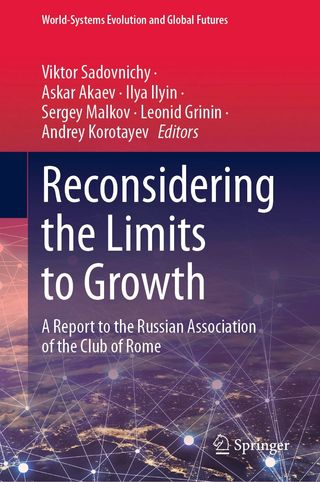
Reconsidering the Limits to Growth. A Report to the Russian Association of the Club of Rome
Springer, 2023.
Similar publications
Proceedings of the 30th International Business Information Management Association Conference (IBIMA)
Madrid: International Business Information Management Association (IBIMA), 2017.
Vision 2020: Sustainable Economic development, Innovation Management, and Global Growth. ...
Added: December 12, 2017
The UK Summit: The G8 at Lough Erne 2013
Newsdesk Communications Ltd, 2013.
Added: July 1, 2013
  • About
  • About
  • Key Figures & Facts
  • Sustainability at HSE University
  • Faculties & Departments
  • International Partnerships
  • Faculty & Staff
  • HSE Buildings
  • HSE University for Persons with Disabilities
  • Public Enquiries
  • Studies
  • Admissions
  • Programme Catalogue
  • Undergraduate
  • Graduate
  • Exchange Programmes
  • Summer University
  • Summer Schools
  • Semester in Moscow
  • Business Internship
  • Research
  • International Laboratories
  • Research Centres
  • Research Projects
  • Monitoring Studies
  • Conferences & Seminars
  • Academic Jobs
  • Yasin (April) International Academic Conference on Economic and Social Development
  • Media & Resources
  • Publications by staff
  • HSE Journals
  • Publishing House
  • iq.hse.ru: commentary by HSE experts
  • Library
  • Economic & Social Data Archive
  • Video
  • HSE Repository of Socio-Economic Information
  • HSE1993–2026
  • Contacts
  • Copyright
  • Privacy Policy
  • Site Map
Edit