?
Birchbark Literacy and the Rise of Written Communication in Early Rus’
P. 225–251.
The paper discusses the origin of pragmatic writing in Early Rus’ and its relationship to the Church Slavonic tradition. The emergence of birchbark literacy in Novgorod at about 1030 is treated as a by-product of the spread of church education under the reign of Jaroslav the Wise. The intermingling of lay and ecclesiastic affairs in the life of Lyudin konec of Novgorod is shown to have produded the breeding ground for the proliferation of birchbark writing in this part of the city.
In book
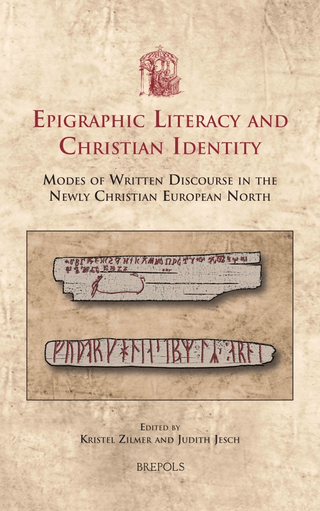
Turnhout: Brepols Publishers, 2012.
Stefanovich P., Herald of the Russian Academy of Sciences 2026 Vol. 96 No. Supplement 3 P. 178–188
The paper provides a review of various interpretations of the concept of rus’/Rus’ land currently
debated in contemporary scholarship. Defining the meaning of this concept is of fundamental importance
for understanding the earliest period of East Slavic statehood, spanning from the 9th to the mid-13th century.
The study demonstrates that the concept of “Old Russian nationality” (drevnerusskaya narodnost’), widely
accepted ...
Added: September 8, 2026
Лавренченко М. Л., В кн.: Восточная Европа в древности и средневековье. Чтения памяти члена-корреспондента АН СССР В.Т. Пашуто. Выпуск XXXVIII. Будущее в настоящем: предсказания, знамения, видения, сны.: М.: ИВИ РАН, 2026. С. 109–114.
The article examines the use of the lexeme *veremya* (*vremya*) — in the sense of "possible future conditions" — in the treaties of the Rurikid princes found in the Kievan Chronicle and in treaties of the 13th and 14th centuries. ...
Added: August 19, 2026
Vinogradov A., Chkhaidze V., Bulletin of the National Institute of Archaeology 2026 Vol. 51 P. 97–102
The work is dedicated to identifying the Christian name of Prince Rostislav Vladimirovich (CA. 1038-1067/8), ruler the Matarcha-Tmutarakan in 1064-1067/8. In 2016 in Belarus (territory of Polotsk Principality) was found a seal with an image of Annunciation on the obverse and legend "Virgin Mary, save Gabriel Rostislav" on the reverse . It follows that the ...
Added: July 1, 2026
Аракчеев В. А., Древняя Русь. Вопросы медиевистики 2024 Т. 97 № 3 С. 104–116
The article is devoted to the phenomenon of corruption in the Russian state at the end of the 16th century. The study was carried out on the basis of an archival file, which was not published and was not reflected in the published works of historians. The purpose of the article is to reconstruct the ...
Added: June 11, 2026
Коррупция в системе местного управления Русского государства (по следственным делам 1590-1630-х гг.)
Аракчеев В. А., Вестник Волгоградского государственного университета. Серия 4: История. Регионоведение. Международные отношения 2024 Т. 29 № 5 С. 15–27
Introduction. The purpose of the article is to study how corruption was understood in the Moscow state and how the fight against it was carried out in the system of local government to show the vector of institutional shift in the Russian state of the late 16th – first third of the 17th century. Methods and ...
Added: June 11, 2026
Аракчеев В. А., Славяноведение 2026 № 2 С. 5–19
The article presents a retrospective analysis of data on the service organization in the Tver and Vladimir districts in the 16th century, on the basis of which a model of the princely domain in North-Eastern Rus' of the appanage era is constructed. A comparative study of the service organization and other forms of exploitation of ...
Added: June 11, 2026
Vinogradov A., Slovĕne 2025 Т. 14 № 2 С. 38–55
The article deals with the reconstruction of the political governance in Novgorod from the first half to mid-11th century, which was being interpreted very differently due to significant discrepancies in the sources. The Novgorod prince was usually the son of the Kiev one, but not necessarily the eldest (who could also occupy another see, e.g., ...
Added: May 11, 2026
Прошин А. В., Древняя Русь. Вопросы медиевистики 2026 № 3 (105) С. 23–35
Статья посвящена текстологическому анализу и сравнению двух некрологов Владимиру Мономаху в Лаврентьевской и Ипатьевской летописях. Автор устанавливает связь обоих текстов в текстологической перспективе и их место в традиции летописных посмертных панегириков. ...
Added: April 29, 2026
Прошин А. В., Vox Medii Aevi 2025 Т. 1 (12) С. 13–36
Поскольку древнерусским князьям приходилось постоянно принимать участие в походах и сражениях, идеал правителя должен был, несомненно, отражать представления о них как о воинах. Предполагаемая рядом исследователей первостепенная важность воинского образа
князей, включающего их ратные и полководческие качества, однако, не находит подтверждения среди летописных некрологов (посмертных панегириков). Эти текст конструируют посмертный образ князя, отмечая его важнейшие качества ...
Added: April 29, 2026
Артамонов Ю. А., Палеоросия. Древняя Русь: во времени, в личностях, в идеях 2025 № 4 С. 122–131
В статье анализируются названия монастырей Киева домонгольского времени. Автор приходит к выводу, что наиболее широко в этот период использовались агиотопонимы ― названия, образованные от церковных праздников, которым были посвящены соборные храмы монастырей. Иногда они дополнялись указаниями
на местность, где располагались иноческие общины. Необходимость в этих географических уточнениях возрастала по мере увеличения численности киевских монастырей. Использование притяжательных антропотопонимов было ...
Added: March 1, 2026
Артамонов Ю. А., Gippius A., Древняя Русь. Вопросы медиевистики 2025 С. 24–42
The article continues a series of publications on Slavonic-Russian graffiti from the 11th–15th centuries found in the St. Sophia Cathedral (Hagia Sophia) of Constantinople. The reader is offered a description of nine inscriptions identified and recorded in 2008–2009 in the northern gallery. ...
Added: March 1, 2026
Vinogradov A., Древняя Русь. Вопросы медиевистики 2025 № 4(102) С. 58–69
Статья посвящена средневековому перечню новгородских князей. Анализ его текста показывает, что разница между его разделами и частями не столь велика и происходит из-за разницы в стратегии его составителя и использованных им источниках. Этими источниками были для раздела про XI в. не дошедшая до нас летопись Новгородско-Софийской группы, стоящая ближе всего к Новгородской четвертой летописи, а для дальнейшего периода – Новгородская первая ...
Added: December 9, 2025
Gippius A., В кн.: Русское денежное обращение IX—XVII вековТ. 2: Нумизматический сборник к 70-летию Петра Григорьевича Гайдукова.: М.: Институт археологии Российской академии наук, 2025. С. 62–68.
Th e article continues the series of works on Old Russian money-weight systems, launched by the publication of the Novgorod birchbark document No. 1072 of the late 12th century. Th e critical analysis of the alternative interpretation of this document, proposed by A. A. Kupranis and A. A. Popov (2019), allows the author to stay ...
Added: November 20, 2025
Vinogradov A., В кн.: ΔΙΔΑΣΚΑΛΟΣ ΚΑΙ ΣΟΦΟΣ. Сборник статей к 90-летию И.П. Медведева.: СПб.: Индрик, 2025. С. 169–185.
Added: September 23, 2025
Stefanovich P., В кн.: Восточная Европа в древности и средневековье. Чтения памяти члена-корреспондента АН СССР В. Т. Пашуто. Выпуск XXXVII. Этно- и топонимия в социокультурных практикахВып. 37: Этно- и топонимия в социокультурных практиках.: М.: ИВИ РАН, 2025. С. 209–211.
The expression "Russian universe," which appears several times in ancient Russian sources, is analyzed. It is concluded that its meaning is similar to the expression "Russian world." ...
Added: September 23, 2025
Gippius A., Вопросы языкознания 2025 № 4 С. 7–41
This article contains a preliminary publication of 30 birchbark letters found during the 2024 archaeological season at the Troitsky excavation in Veliky Novgorod. The vast majority of the published texts date back to the 12th century. Most important in historical and philological terms are the following items: a letter mentioning a military campaign and related ...
Added: September 21, 2025
М.: ИРИ РАН, ИА РАН, 2025.
The collection contains the materials of the XIII International Conference „An integrated approach to the study of old Rus’.” The central theme of the conference is the anniversary date: the 900th anniversary of the death of Vladimir Monomakh. The authors of the collection's articles are historians, archaeologists, historians of the church, historians of literature and ...
Added: September 18, 2025