?
Центральная Азия на пороге «Ревущих Двадцатых»: Мегатренды прошедшего десятилетия, их последствия и новые фронтиры региона
С. 68–75.
Zhiyenbayev M.
In book
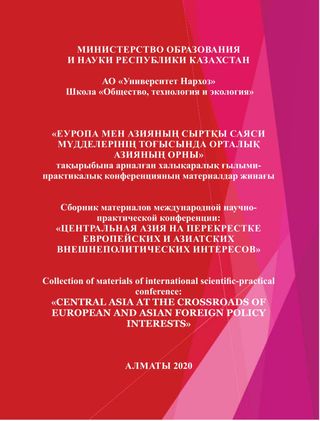
Алматы: Издательство «Фортуна Полиграф», 2020.
Luzyanin S., Умаров О. М., Вестник Российского университета дружбы народов. Серия: Политология 2026 Т. 26 № 2 С. 240–255
A digital model for neutralizing challenges and threats facing Central Asia has been developed, along with a framework for its implementation based on Russian and Central Asian experience in the sphere of regional security. ...
Added: September 11, 2026
Asatryan G., Trenin D., Россия в глобальной политике 2025 Т. 23 № 6 С. 191–205
The armed confrontation between the Russian Federation and the collective West requires focusing its attention and resources on Ukraine. Under extreme circumstances, it is more difficult for Russia to expand or even maintain its position in other neighboring countries.
Moscow has lost its position as the main mediator in the Armenian-Azerbaijani conflict. Its peacekeeping mission in ...
Added: March 20, 2026
Ivanov V., , in: ERNOP Conference Proceedings 2025.: European Research Network on Philanthropy, 2026. P. 90–95.
The historical development of volunteering and philanthropy in Kazakhstan, Kyrgyzstan, Tajikistan, Turkmenistan and Uzbekistan has been studied from ancient times to the present day. It was found that volunteering and charity in Central Asia have common historical roots. Nowdays in all countries surveyed, the state plays an active role in developing philanthropy and volunteering by introducing ...
Added: February 21, 2026
Муравьев Н. Е., Yagunova E. E., Молодой ученый 2024 № 15(514) С. 390–391
По итогам проведенного научного исследования автор сформулировал понятие судебного контроля, судебного нормоконтроля, а также рассмотрел модели судебного нормоконтроля в ряде зарубежных стран. ...
Added: February 7, 2026
Смирнов В. А., Современная Европа 2026 № 1 С. 81–91
The article analyzes the transformation of relations between the European Union and the countries of Central Asia during the first quarter of the 21st century. Three key stages in the evolution of these relations are identified: the formulation of an approach (2000–2010), institutionalization (2011–2019), and the period of geopolitical challenges (2020–2025). The author concludes that ...
Added: February 3, 2026
Zubarevich N., Сафронов С. Г., Региональные исследования 2024 № 1(83) С. 4–18
The article analyzes the level and dynamics of interregional inequality in Russia, Kazakhstan, Uzbekistan, Belarus and some European countries (in terms of NUTS-2 territorial units) according to available data from official statistics of the CIS countries (1995–2022) and Eurostat (2011–2022). The Gini coefficient, weighted by population and normalized depending on the number of territorial units, ...
Added: January 22, 2026
N. V. Zubarevich, Safronov S. G., Regional Research of Russia 2024 Vol. 14 No. 4 P. 513–524
The article analyzes the level and dynamics of interregional inequality in Russia, Kazakhstan, Uzbekistan, and Belarus versus other European countries based on data from official statistics of CIS countries (1995–2022) and Eurostat (2011–2022). The Gini coefficient, weighted by population and normalized depending on the number of territorial units, is used as the main assessment parameter. ...
Added: January 22, 2026
Tebin, P.Yu., Russia in Global Affairs 2026 Vol. 24 No. 1 P. 134–148
This article contends that, in the context of growing, multifaceted, and long-term great-power competition, Russian national security depends upon developing a Eurasian transport network through a cohesive ‘whole-of-government’ approach. Such a network includes robust domestic infrastructure as well as a diversified and resilient network of international transport corridors, foremost the International North-South Transport Corridor (INSTC) ...
Added: January 12, 2026