• A
  • A
  • A
  • АБВ
  • АБВ
  • АБВ
  • A
  • A
  • A
  • A
  • A
Обычная версия сайта
  • RU
  • EN
  • HSE University
  • Publications
  • Book chapter
  • EEG correlates of false information processing
  • RU
  • EN
Расширенный поиск
Высшая школа экономики
Национальный исследовательский университет
Priority areas
  • business informatics
  • economics
  • engineering science
  • humanitarian
  • IT and mathematics
  • law
  • management
  • mathematics
  • sociology
  • state and public administration
by year
  • 2027
  • 2026
  • 2025
  • 2024
  • 2023
  • 2022
  • 2021
  • 2020
  • 2019
  • 2018
  • 2017
  • 2016
  • 2015
  • 2014
  • 2013
  • 2012
  • 2011
  • 2010
  • 2009
  • 2008
  • 2007
  • 2006
  • 2005
  • 2004
  • 2003
  • 2002
  • 2001
  • 2000
  • 1999
  • 1998
  • 1997
  • 1996
  • 1995
  • 1994
  • 1993
  • 1992
  • 1991
  • 1990
  • 1989
  • 1988
  • 1987
  • 1986
  • 1985
  • 1984
  • 1983
  • 1982
  • 1981
  • 1980
  • 1979
  • 1978
  • 1977
  • 1976
  • 1975
  • 1974
  • 1973
  • 1972
  • 1971
  • 1970
  • 1969
  • 1968
  • 1967
  • 1966
  • 1965
  • 1964
  • 1963
  • 1958
  • More
Subject
News
May 25, 2026
HSE Scientists Train Neural Network to 'Hear' Faults in Electric Motors
Researchers at the AI and Digital Science Institute of the HSE Faculty of Computer Science have developed a new method—the Signature-Guided Data Augmentation (SGDA) framework—that achieves 99% accuracy in motor fault detection and 86% accuracy in fault classification. The application of this approach can reduce industrial equipment repair costs, minimise downtime, and improve production safety. The study results have been published in Engineering Applications of Artificial Intelligence.
May 25, 2026
'The Humanities Serve as a Conscience'
Maria Mizernaia studies Soviet literature and the history of book publishing. In this interview for the HSE Young Scientists project, she discusses plans to publish a novel about besieged Leningrad, AI-provoked reflections on what it means to be human, and how novels can help satisfy our dopamine hunger.
May 25, 2026
Is It Possible to Predict a Citys Life Based on the Shape of Its Neighbourhoods?
Is it possible to predict, based on the configuration of streets and buildings, where a café will open or where traffic congestion will occur? Participants in the Spatial Analysis and Modelling of Urban Processes research and study group use open data and machine learning to identify universal patterns. Alexander Sheludkov and Eduard Somov discuss the purpose of comparing cities, the need for new forms of urban statistics, and how open data is transforming approaches to urban studies.


Have you spotted a typo?
Highlight it, click Ctrl+Enter and send us a message. Thank you for your help!

Publications
  • Books
  • Articles
  • Chapters of books
  • Working papers
  • Report a publication
  • Research at HSE

?

EEG correlates of false information processing

P. 53–54.
Martín-Luengo B., Mikhailova L., Seungah L., Kapitsyn M., Myachykov A., Shtyrov Y.

Human memory is not a literal record of our experiences but a fallible and malleable cognitive process. Because of the reconstructive nature of memory, we are often prone to accept false events and recall them as truthful (Bartlett, 1932). One easy and reliable method to create and study false memories in the laboratory is the misinformation paradigm. In this paradigm participants are presented with a story (original information). After some time, parts of this story are presented again but now including some modifications (misinformation). Finally, the memory is measured for the original information, the misinformation, and, as control, some other incorrect information never presented before. The misinformation effect occurs when the percentage of misinformation accepted is higher than the acceptance of control incorrect information. This effect has been largely studied in relation to its applied relevance in eyewitness testimony research. Yet, the neural substrates and temporal dynamics of processing correct and false information remain scarcely studied. In this study the neural activity was recorded using EEG while participants performed a memory recognition test which comprised misinformation, true, and simply incorrect items. The only previous EEG study on neural correlates focused on misinformation pointed to the P3b and LPC (late positive component) ERPs components as the key to distinguishing between memories for correct and false memories. High P3b is linked with a strong match between the expectation and the stimuli presented. LPC is a late component around 400 to 800 ms after the stimulus presentation, associated with the recollection of accurate information.
Our results show that for the contrasts of misinformation accepted vs rejected, and false information accepted vs rejected (correct rejections), P3b was significantly more positive when the inaccurate information was accepted. These differences suggest a larger cognitive workload on accepting this type of information than when it is correctly rejected. Furthermore, in both contrasts we found differences in P600 which is linked to reprocessing of detected anomalies in the input. Here, we found a more expressed P600 for accepted than for rejected misinformation. P600 was also stronger for correct rejections than false alarms. In this latter case, the higher P600 amplitude may reflect the detection and reanalysis of the rejection of this false information. Interestingly, in the case of acceptance of misinformation, the higher P600 amplitude suggest that participants are not totally blind to the inaccuracy of the misinformation, though still they accept it.

The work was supported by the Russian Science Foundation (project №19-18-00534).

Language: English
Full text
Text on another site
Keywords: P600EEGP600False informationEEGfalse information
Publication based on the results of:
Investigations of neuronal mechanisms of cognition and decision making: neuroimaging, computational models and non-invasive brain stimulation (2019)

In book

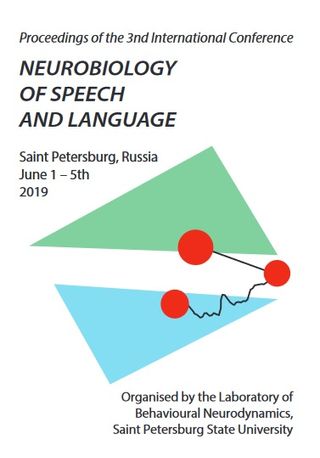
Proceedings of the 3rd International Conference Neurobiology of Speech and Language
Scifiya-print, 2019.
Similar publications
Multimodal EEG, ECG, and video dataset of yoga practitioners during concentration and mind-wandering tasks
Kashevnik A., Glekler E., Artemenko E. et al., Scientific data 2026 Article 7209
We present a multimodal dataset containing electroencephalography (EEG), electrocardiography (ECG), and video recordings from 49 participants. Each participant completed a single session lasting approximately 45 minutes. During each session they performed five tasks: resting state, inward concentration (focusing on the center of the forehead), outward concentration (visual search), and mind-wandering. EEG data were recorded from ...
Added: April 23, 2026
Компьютерные игры как среда для психологических исследований
Momotenko D., Цепелевич М., Ткаченко И. et al., Психология. Психофизиология 2025 Т. 18 № 2 С. 34–46
Introduction. Video games constitute a special form of digital media characterized by dynamic environments that respond to players’ actions and integrated algorithms. Within psychological research, video games offer better validity compared to traditional automated assessment systems, enabling a naturalistic investigation of various phenomena. Furthermore, video games shape mental processes. These features are widely exploited in international psychological research and are critical ...
Added: April 17, 2026
Retention of Emotional and Socio-Emotional Information in Working Memory: EEG Functional Connectivity Study
Kochetkova E., Machinskaya R., Human Physiology 2025 Vol. 51 No. 6 P. 580–590
Growing evidence suggests the specific systems for emotional information maintenance and processing in working memory, highlighting the role of cognitive domains in emotional awareness. The question of neural basis of social-emotional processing in working memory remains open. We hypothesized that the neural systems supporting working memory for emotional processing may rely on shared ‘core’ networks ...
Added: April 15, 2026
Динамика синхронизации и десинхронизации ЭЭГ при выполнении реального и мысленного движения руки, направленного к видимой цели
Курганская М. Е., Исаев М. Р., Бобров П. Д., Журнал высшей нервной деятельности им. И.П. Павлова 2024 Т. 74 № 2 С. 210–222
The work investigates spatial and temporal EEG patterns during real and imagined execution of hand reaching. Six independent sources of electrical activity were identified in the EEG recordings. The sources corresponded to the premotor areas, supplementary motor area, primary motor areas, and posterior parietal cortex. Their activation patterns in the alpha and beta range were ...
Added: March 11, 2026
An inclusive paradigm to study mu-rhythm properties
Mitiureva D., Pavel Bobrov, Rebreikina A. et al., International Journal of Psychophysiology 2023 Vol. 190 P. 42–55
Studying mu-rhythm in developmental disorders is crucial for identifying the origin of motor and social malfunctioning. However, the commonly used mu-rhythm experimental protocol, that requires following instructions, is challenging for children with motor and cognitive deficits. Here we present an inclusive experimental procedure that contains passive hand movement, closed and open eyes and hand movement ...
Added: March 11, 2026
Отслеживание изменений уровня бодрствования с помощью рассчитываемых по спектральной мощности ЭЭГ-индексов
Соловьева А. К., Исаев М. Р., Бобров П. Д. et al., Журнал высшей нервной деятельности им. И.П. Павлова 2025 Т. 75 № 6 С. 756–769
There is a need for empirical indicators that can monitor subtle changes in wakefulness levels with high temporal resolution. We aimed to assess the applicability in this regard of several indices based on the  average spectral power of EEG rhythms, as well as the BIS index used in anesthesiology. 26 volunteers participated in an experiment involving forced awakenings ...
Added: March 6, 2026
EEG Source Localization of μ-Rhythm Event-Related Desynchronization during Tactile Imagery
Petrova D., Moscow University Biological Sciences Bulletin 2024
Added: January 18, 2026
Qualitative and Quantitative Comparative Analysis of Common Normal Variants and Physiological Artifacts in MEG and EEG
Kleeva D., Sinkin M., Shtekleyn A. et al., Brain Topography 2025 Vol. 38 Article 75
Magnetoencephalography (MEG) and electroencephalography (EEG) provide complementary insights into brain activity, yet their distinct biophysical principles influence how normal neurophysiological patterns and artifacts are represented. This study presents a comprehensive qualitative and quantitative analysis of common physiological variants and artifacts in simultaneously recorded MEG and EEG data. We systematically examined patterns such as alpha spindles, ...
Added: November 29, 2025
Brain Topography A Journal of Cerebral Function and Dynamics
Kleeva D., Sinkin M., Shtekleyn A. et al., Springer, 2025.
Magnetoencephalography (MEG) and electroencephalography (EEG) provide complementary insights into brain activity, yet their distinct biophysical principles influence how normal neurophysiological patterns and artifacts are represented. This study presents a comprehensive qualitative and quantitative analysis of common physiological variants and artifacts in simultaneously recorded MEG and EEG data. We systematically examined patterns such as alpha spindles, ...
Added: November 29, 2025
The electroencephalogram based classification of internally pronounced phonemes
Gavrilenko Y., Saada D., Ilyushin E. et al., Advances in Intelligent Systems and Computing 2021 Vol. 1310 P. 97–105
The internal speech recognition is a promising technology, which could find its use in brain-computer interfaces development and greatly help those who suffer from neurodegenerative diseases. The research in this area is in its early stages and is associated with practical value, which makes it relevant. It is known that internal pronunciation can be restored ...
Added: October 2, 2025
Reconstruction of Words, Syllables, and Phonemes of Internal Speech by EEG Activity
Suyuncheva A., Saada D., Gavrilenko Y. et al., Advances in Intelligent Systems and Computing 2021 Vol. 1358 P. 319–328
In this article, the process of internal pronunciation (covert speech) is associated with the internal speech through an intellectual process such as silent reading. The objective of the research is to compare the EP of visual and auditory perception and internal pronunciation of phonemes and syllables; to classify phonemes, words and syllables from covert speech, ...
Added: October 2, 2025
Механизмы внутреннего проговаривания и восприятия при разных типах внешней инициации
Вартанов А. В., Суюнчева А. Р., Шевченко А. О., Интеллектуальные системы. Теория и приложения 2021 Т. 25 № 4 С. 302–306
The electrical activity of the brain was detected in tasks on the perception and pronunciation of individual phonemes and syllables of the Russian language under various conditions of initiation of the pronunciation process. The conditions for initiation were visual presentation (a letter was shown), auditory presentation, and also auditory presentation of conditioned stimuli (words in ...
Added: October 2, 2025
C.R.A.B.: a gamified paradigm for studying readiness potential
Evgeny Blagovechtchenski, Maria Koriakina, Ksenia Bartseva et al., Frontiers in Human Neuroscience 2025 No. 19 Article 1534412
Background: This study presents a novel paradigm termed Contrasting Routines Affecting Bereitschaftspotential (C.R.A.B.), designed to analyze readiness potential (RP) waveforms preceding movements across varying experimental settings. This paradigm continues Libet's work on decision-making, with an emphasis on the motor planning component like in classical Libet experiment. However, existing paradigms for studying RP work poorly across ages ...
Added: September 4, 2025
Synaptic inhibitory dynamics drive benzodiazepine response in pediatric status epilepticus
Fedele T., Burman R. J., Steinberg A. et al., Epilepsia 2025 Vol. 66 No. 8 P. 2980–2994
Together, our findings confirm that alterations in synaptic inhibition underlie BZP response during pediatric SE. More broadly, this work further demonstrates the utility of computational modeling to validate insights from basic science in clinically accessible recordings in neurological disorders characterized by abnormal brain states. ...
Added: August 28, 2025
Neurophysiological evidence of single-shot semantic mapping in the developing brain
Vasilyeva M., Knyazeva V., Elena D. Artemenko et al., Frontiers in Human Neuroscience 2025 Vol. 19 Article 1533833
Rapid acquisition of new words and construction of large vocabularies is a unique capacity of developing human brain. This process is to a large degree mediated by a neurocognitive mechanism known as «fast mapping» (FM) which allows the child to quickly map new words onto neural representations after even a single exposure to them, using ...
Added: July 31, 2025
Developmental Changes in Presentation Rate Effect on Auditory Event-Related Potential through Childhood to Adulthood
Kostanian D. G., Rebreikina A. B., Sysoeva O.V., RUDN Journal of Psychology and Pedagogics 2024 Vol. 21 No. 1 P. 96–114
Abstract. In adults, the rate of stimuli presentation has been shown to play a critical role for the event related potentials (ERP): its components become larger as presentation rate decreases. But there are few works evaluating developmental changes of this ERP modulation that might provide insights into basic forms of learning. The current study aims ...
Added: July 7, 2025
Психофизиологические маркеры исполнительных функций при копировании предложений
Momotenko D., Горбунов И. А., Экспериментальная психология 2024 Т. 17 № 4 С. 208–221
Typing is a multi-level process involving executive and motor functions. Due to its hierarchical organization, it becomes possible to study the psychophysiological features of higher mental functions in the natural environment by analyzing automated motor activity. The purpose of this work is to identify psychophysiological correlates of executive functions through computer typing. This study presents ...
Added: April 28, 2025
  • About
  • About
  • Key Figures & Facts
  • Sustainability at HSE University
  • Faculties & Departments
  • International Partnerships
  • Faculty & Staff
  • HSE Buildings
  • HSE University for Persons with Disabilities
  • Public Enquiries
  • Studies
  • Admissions
  • Programme Catalogue
  • Undergraduate
  • Graduate
  • Exchange Programmes
  • Summer University
  • Summer Schools
  • Semester in Moscow
  • Business Internship
  • Research
  • International Laboratories
  • Research Centres
  • Research Projects
  • Monitoring Studies
  • Conferences & Seminars
  • Academic Jobs
  • Yasin (April) International Academic Conference on Economic and Social Development
  • Media & Resources
  • Publications by staff
  • HSE Journals
  • Publishing House
  • iq.hse.ru: commentary by HSE experts
  • Library
  • Economic & Social Data Archive
  • Video
  • HSE Repository of Socio-Economic Information
  • HSE1993–2026
  • Contacts
  • Copyright
  • Privacy Policy
  • Site Map
Edit