• A
  • A
  • A
  • АБВ
  • АБВ
  • АБВ
  • A
  • A
  • A
  • A
  • A
Обычная версия сайта
  • RU
  • EN
  • HSE University
  • Publications
  • Book chapter
  • The Methods of Cognitonics as the Basis for Designing Intelligent Tutoring Systems Developing Emotional Intelligence of the Learners
  • RU
  • EN
Расширенный поиск
Высшая школа экономики
Национальный исследовательский университет
Priority areas
  • business informatics
  • economics
  • engineering science
  • humanitarian
  • IT and mathematics
  • law
  • management
  • mathematics
  • sociology
  • state and public administration
by year
  • 2028
  • 2027
  • 2026
  • 2025
  • 2024
  • 2023
  • 2022
  • 2021
  • 2020
  • 2019
  • 2018
  • 2017
  • 2016
  • 2015
  • 2014
  • 2013
  • 2012
  • 2011
  • 2010
  • 2009
  • 2008
  • 2007
  • 2006
  • 2005
  • 2004
  • 2003
  • 2002
  • 2001
  • 2000
  • 1999
  • 1998
  • 1997
  • 1996
  • 1995
  • 1994
  • 1993
  • 1992
  • 1991
  • 1990
  • 1989
  • 1988
  • 1987
  • 1986
  • 1985
  • 1984
  • 1983
  • 1982
  • 1981
  • 1980
  • 1979
  • 1978
  • 1977
  • 1976
  • 1975
  • 1974
  • 1973
  • 1972
  • 1971
  • 1970
  • 1969
  • 1968
  • 1967
  • 1966
  • 1965
  • 1964
  • 1963
  • 1958
  • More
Subject
News
October 1, 2026
HSE Researchers Show How Congenital Motor Disorders Affect Brain Development
Researchers from HSE University’s Institute for Cognitive Neuroscience have synthesised the findings of their previous studies on brain development in children with obstetric brachial plexus palsy and arthrogryposis. Their analysis shows that impaired motor function in early childhood not only limits children’s motor experience but also affects memory, categorical thinking, and information processing. The study has been published in Frontiers in Psychology.
October 1, 2026
Window into the Body: Scientists Develop Neural Network to Detect Risk of 15 Diseases from Retinal Images
Russian universities, with the participation of HSE University, Sber, and Z-union, have developed a neural network that can simultaneously assess the risk of 15 types of pathology from retinal photographs, including not only eye diseases but also cardiovascular conditions. The AI system can help clinicians detect potentially concerning changes at an early stage, identify signs reflecting the condition of retinal blood vessels, and determine whether a patient may need further examination. The paper has been published in Frontiers in Medicine.
September 30, 2026
'We Did Not Limit the Time for Questions'
The International Laboratory for Supercomputer Atomistic Modelling and Multi-Scale Analysis at HSE University held a major conference on molecular dynamics. Participants had the opportunity to attend all the presentations, while speakers were given as much time as they needed to answer questions. The HSE News Service interviewed Grigory Smirnov, Head of the Laboratory, and Genri Norman, Chief Research Fellow, about the conference preparations and the discussions it generated.


Have you spotted a typo?
Highlight it, click Ctrl+Enter and send us a message. Thank you for your help!

Publications
  • Books
  • Articles
  • Chapters of books
  • Working papers
  • Report a publication
  • Research at HSE

?

The Methods of Cognitonics as the Basis for Designing Intelligent Tutoring Systems Developing Emotional Intelligence of the Learners

P. 17–21.
Fomichov V. A.

The constructive core of cognitonics, or the science about the human being in the digital world, includes the system of  the methods of emotional-imaginative teaching (the EIT-system). This  system is aimed at systematic development of emotional intelligence (personal competence and social competence), reasoning skills, sound creativity, language skills, and communication culture at the lessons of language (mother tongue and second language), literature and poetry in two languages (on the example of Russian and English), symbolic languages of painting, sculpture, garden-park art, classic dance. The goal of this paper is revealing to the designers of intelligent tutoring systems (ITSs) the broad prospects of constructing a new generation of ITSs opened by the EIT-system. The principal peculiarities of the discussed new generation of ITSs are to be: (a) taking into account emotional intelligence of children as the basis for designing ITSs; (b) as a consequence, making much easier for children and adolescents the grasping of the pieces of theoretical materials to be learned; (c) for the majority of the systems belonging to this new class, contributing to early socialization of children.

Language: English
Full text
Keywords: emotional intelligenceearly socialization of childrentheory of dynamic conceptual mappingscognitonicscognitive engagementsystem of emotional-imaginative teachingcreativity developmentintelligent tutoring systemsocial competence

In book

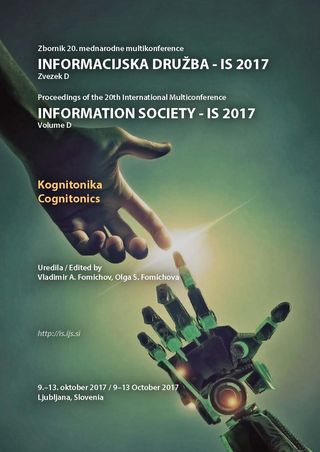
Zbornik 20. mednarodne multikonference INFORMACIJSKA DRUZBA - IS 2017. Zvezek D. Proceedings of the 20th International Multiconference INFORMATION SOCIETY - IS 2017, Volume D. Kognitonika/Cognitonics. Uredila / Edited by Vladimir A. Fomichov, Olga S. Fomichova. 9.-13. oktober 2017/ 9th - 13th October 2017, Ljubljana, Slovenia
Ljubljana: Jozef Stefan Institute, 2017.
Similar publications
Cognitive engagement and video watching behaviours in learner-controlled environments: A cognitive load perspective
Gorbunova A., Getman A., Savelyev A. et al., Innovations in Education and Teaching International 2026 P. 1–13
Research on video-based learning often relies on behavioural indicators to infer engagement, yet it remains unclear whether these behaviours reflect meaningful cognitive engagement or mere activity. To address this gap the present study analysed relationships between time-on-video, click frequency, playback speed manipulation, and learners’ intrinsic, extraneous, and germane cognitive load in a learner-controlled video environment ...
Added: June 14, 2026
Intelligence Types Predict Different Domains of Emotional Creativity Through Self-Assessed Creativity and Intelligence
Kornilova T. V., Chumakova M., Maksarova L. B., Psychology in Russia: State of the Art 2025 Vol. 18 No. 1 P. 60–82
Background. This study is based on the idea of unity between affect and intelligence. It explores how different types of intelligence (fluid, verbal, self-assessed, and emotional) contribute to emotional creativity and implicit theories of creativity and emotion. Objective. To identify the contributions of various types of intelligence to emotional creativity and the implicit theories of creativity and ...
Added: August 18, 2025
СоциальнаЯ компетентность подростков: роль социального познания и контроля поведения
Виленская Г. А., Лебедева Е. И., Уланова А. Ю., Вестник Российского университета дружбы народов. Серия: Психология и педагогика 2023 Т. 20 № 3 С. 588–608
Social competence during adolescence plays a crucial role in socialization and psychological well-being. Available data suggest that social cognition (theory of mind, ToM) and self-regulation (behavioral control) abilities make a significant contribution to social competence at a young age, but research on their role in adolescence is still limited. The purpose of the research is ...
Added: January 7, 2025
Социальная компетентность у подростков с разным уровнем развития модели психического
Лебедева Е. И., Виленская Г. А., Уланова А. Ю. et al., Психологический журнал 2023 Т. 44 № 1 С. 43–54
The aim of this study was to explore the role of theory of mind - the ability to attribute mental states to other people to explain their behavior - in the development of social competence and prosocial behavior in adolescence. It is assumed that there is a difference in the manifestation of prosocial behavior and ...
Added: December 26, 2024
Анализ опыта использования МООК как компонента университетского курса иностранного языка
Bogolepova S., Вестник Томского государственного университета 2021 Т. 473 С. 170–176
Massive Open Online Courses (MOOСs) have been gaining popularity both in the formal educational sector and among individuals who want to gain new skills. MOOCs provide access to up-to-date learning materials and the best instructors, help develop learners’ self-regulation and time-management skills. When integrated into a discipline, MOOCs bring in variety and novelty. Despite the growing popularity of ...
Added: March 28, 2022
Intelligent Virtual Reality Tutoring Systems as a New Generation of Simulators: Requirements and Opportunities
Dudyrev F., Maksimenkova O. V., Mikhailenko D., , in: Proceedings of the IEEE Global Engineering Education Conference (EDUCON 2021).: IEEE, 2021. P. 706–718.
Added: June 29, 2021
EMOTIONAL INTELLIGENCE AS THE BASIS FOR EMPLOYEE PSYCHOLOGICAL WELL-BEING
Isaeva O., Kuragina M., , in: BUSINESS TRENDS: RESEARCH AGENDA IN INNOVATIONS AND ENTREPRENEURSHIP. Collection of scientific papers.: -, 2020. P. 52–59.
Abstract. Emotional intelligence is the ability to perceive and understand information contained in emotions, use it to guide thinking, facilitate problem-solving and decision-making. It is an important aspect of an individual’s professional activity and well-being in the working environment. Psychological well-being is an integral mental phenomenon, a holistic experience that reflects the success of an ...
Added: January 30, 2021
Развитие эмоционального интеллекта в профессиональной подготовке студентов – hr-менеджеров
Isaeva O., Savinova S. Y., В кн.: Герценовские чтения: психологические исследования в образовании. Материалы I Международной научно-практической конференцииЧ. 1.: СПб.: Издательство РГПУ им. А.И. Герцена, 2018. С. 77–82.
Emotional intelligence is regarded as one of the most important professional competencies of managers and specialists in human resources services. The efficiency of the whole company depends on the extent to which an HR manager is able to identify his or her emotions, the emotions of clients and employees, and also the way he or ...
Added: October 29, 2018
Когнитоника и ее значение для образования в цифровом веке
Fomichov V. A., Fomichova O. S., М.: ООО «Макс Пресс», 2018.
Книга состоит из трех частей и двух приложений. Значительная часть материалов книги опубликована в 70 научных работах  авторов на английском и французском языках в международных научных изданиях, вышедших в 15 странах. В первой части обосновывается актуальность поддержки и развития идеальной  составляющей личности в обществе знаний (это относится и к представителям конструктивного бизнеса). Вторая часть начинается ...
Added: October 25, 2018
Emotional Intelligence, Patterns for coping with decisional conflict and Academic Achievement in Cross-cultural prospective (evidence from selective Russian and Azerbajani student populations)
Kornilova T., Chumakova M., Krasavtseva Y., Psychology in Russia: State of the Art 2018 Vol. 11 No. 2 P. 114–133
Background. Choice, under conditions of uncertainty, is mediated by integral dynamic regulatory systems that represent hierarchies of cognitive and personality processes. As such, individual decision-making patterns can be studied in the context of intellectual and personality potential. This article presents the results of a cross-cultural comparison of personality characteristics, such as coping with uncertainty, emotional intelligence, ...
Added: October 1, 2018
ЭМОЦИОНАЛЬНЫЙ ИНТЕЛЛЕКТ СТУДЕНТОВ – HR-МЕНЕДЖЕРОВ
Гришина А. В., Isaeva O., Savinova S. Y., Вестник Мининского университета 2018 Т. 6 № 2 С. 1–14
Introduction: Emotional intelligence is one of the key abilities of the modern managers and HR managers. In this study we assess the level of emotional intelligence among students studying Human Resources Management at HSE in Nizhny Novgorod. The study involved 78 students: 56 people (71.79% of the total sample) were undergraduate students and 22 people ...
Added: July 24, 2018
EXPLORING EMOTIONAL INTELLIGENCE IN HIGHER EDUCATION: MANAGEMENT PROGRAMME STUDENTS IN RUSSIA
Kotomina O., Sazhina A., / NRU Higher School of Economics. Series EDU "Education". 2018.
Added: June 1, 2018
Are emotionally intelligent people more emotionally stable? An experience sampling study
Lyusin D., Mohammed A., / Series WP BRP "PSYCHOLOGY". 2018.
The temporal dynamic characteristics of mood play an important role in various aspects of our lives including our psychological health and well-being. It is assumed that the individuals with high emotional intelligence (EI) are characterized by more positive and stable moods. However, most studies analyze how EI is related to emotional traits or momentary assessments ...
Added: April 9, 2018
Is emotional intelligence related to mood dynamics?
Mohammed A., Lyusin D., , in: Теория и практика культурно-исторической психологии: Материалы XVIII Международных чтений памяти Л.С. Выготского. Москва, 13 17 ноября 2017 г.Ч. 1.: М.: Левъ М, 2017. P. 104–107.
Relationships between emotional intelligence and mood have bee studied. Inertia of positive mood positively correlates with interpersonal emotional intelligence. ...
Added: March 4, 2018
The Student-Self Oriented Learning Model as a Paradigm for Supporting and Developing Emotional Intelligence and Creativity
Fomichov V. A., , in: Zbornik 20. mednarodne multikonference INFORMACIJSKA DRUZBA - IS 2017. Zvezek D. Proceedings of the 20th International Multiconference INFORMATION SOCIETY - IS 2017, Volume D. Kognitonika/Cognitonics. Uredila / Edited by Vladimir A. Fomichov, Olga S. Fomichova. 9.-13. oktober 2017/ 9th - 13th October 2017, Ljubljana, Slovenia.: Ljubljana: Jozef Stefan Institute, 2017. P. 11–16.
Proceeding from broadly accepted role of emotional intelligence (EI) in professional and personal life, the paper suggests a new learning model (LM) called Student-Self Oriented LM (SSOL-model). It is defined as the model being beneficial for self-cognition and self-construction through the prism of the acquired knowledge and life experience. A successful implementation of the SSOL-model ...
Added: February 12, 2018
Zbornik 20. mednarodne multikonference INFORMACIJSKA DRUZBA - IS 2017. Zvezek D. Proceedings of the 20th International Multiconference INFORMATION SOCIETY - IS 2017, Volume D. Kognitonika/Cognitonics. Uredila / Edited by Vladimir A. Fomichov, Olga S. Fomichova. 9.-13. oktober 2017/ 9th - 13th October 2017, Ljubljana, Slovenia
Ljubljana: Jozef Stefan Institute, 2017.
The book contains 17 papers presented at the Fifth International Conference on Cognitonics - Cognit-2017 (Slovenia, Ljubljana, Jozef Stefan Institute, 9-10 October 2017)  as a part of the 20th International Multiconference ‘Information Society’ - IS 2017, organized by the Jožef Stefan Institute. The papers are submitted by 36 researchers from 16 countries of the world: PR ...
Added: February 8, 2018
  • About
  • About
  • Key Figures & Facts
  • Sustainability at HSE University
  • Faculties & Departments
  • International Partnerships
  • Faculty & Staff
  • HSE Buildings
  • HSE University for Persons with Disabilities
  • Public Enquiries
  • Studies
  • Admissions
  • Programme Catalogue
  • Undergraduate
  • Graduate
  • Exchange Programmes
  • Summer University
  • Summer Schools
  • Semester in Moscow
  • Business Internship
  • Research
  • International Laboratories
  • Research Centres
  • Research Projects
  • Monitoring Studies
  • Conferences & Seminars
  • Academic Jobs
  • Yasin (April) International Academic Conference on Economic and Social Development
  • Media & Resources
  • Publications by staff
  • HSE Journals
  • Publishing House
  • iq.hse.ru: commentary by HSE experts
  • Library
  • Economic & Social Data Archive
  • Video
  • HSE Repository of Socio-Economic Information
  • HSE1993–2026
  • Contacts
  • Copyright
  • Privacy Policy
  • Site Map
Edit