• A
  • A
  • A
  • АБВ
  • АБВ
  • АБВ
  • A
  • A
  • A
  • A
  • A
Обычная версия сайта
  • RU
  • EN
  • HSE University
  • Publications
  • Book chapter
  • Отсутствие зависти в задачах распределения большого числа неделимых благ
  • RU
  • EN
Расширенный поиск
Высшая школа экономики
Национальный исследовательский университет
Priority areas
  • business informatics
  • economics
  • engineering science
  • humanitarian
  • IT and mathematics
  • law
  • management
  • mathematics
  • sociology
  • state and public administration
by year
  • 2028
  • 2027
  • 2026
  • 2025
  • 2024
  • 2023
  • 2022
  • 2021
  • 2020
  • 2019
  • 2018
  • 2017
  • 2016
  • 2015
  • 2014
  • 2013
  • 2012
  • 2011
  • 2010
  • 2009
  • 2008
  • 2007
  • 2006
  • 2005
  • 2004
  • 2003
  • 2002
  • 2001
  • 2000
  • 1999
  • 1998
  • 1997
  • 1996
  • 1995
  • 1994
  • 1993
  • 1992
  • 1991
  • 1990
  • 1989
  • 1988
  • 1987
  • 1986
  • 1985
  • 1984
  • 1983
  • 1982
  • 1981
  • 1980
  • 1979
  • 1978
  • 1977
  • 1976
  • 1975
  • 1974
  • 1973
  • 1972
  • 1971
  • 1970
  • 1969
  • 1968
  • 1967
  • 1966
  • 1965
  • 1964
  • 1963
  • 1958
  • More
Subject
News
September 25, 2026
AI Users Earn Up to 41.8% More Than Non-Users
Research conducted by economists at HSE University has revealed a significant correlation between the regular use of GenAI in the workplace and higher pay among Russian employees. The study found that individuals who frequently use GenAI in their professional activities earn notably more than those who reject these new tools or resort to them occasionally. The salary premium for highly qualified specialists reaches 41.8%. The article was published in the Voprosy Ekonomiki journal.
September 24, 2026
‘Feedback and Constructive Criticism Are Essential in Our Profession
Vincent Fardeau, Associate Professor at HSE ICEF, has reached a major career milestone: he recently published his paper ‘Asymmetric Thin Markets’ in the Journal of Financial Economics, successfully passed his major academic review, and received tenure. In this interview, Vincent discusses the story behind the paper, explains the concept of asymmetric thin markets, and shares his advice for young scholars aiming to publish in top-tier journals.
September 22, 2026
Personal Interest in Doctoral Thesis Topic Most Important for Confidence in Successful Defence
A researcher at HSE University analysed data on 1,539 doctoral students from 161 Russian universities to identify which features of a thesis topic are associated with academic success and engagement. The most important factor was found to be personal interest in the research topic, which was associated with almost all key aspects of doctoral programme experience—from engaging with the academic supervisor to research activity and confidence about successfully defending the thesis. The findings have been published in Higher Education.


Have you spotted a typo?
Highlight it, click Ctrl+Enter and send us a message. Thank you for your help!

Publications
  • Books
  • Articles
  • Chapters of books
  • Working papers
  • Report a publication
  • Research at HSE

?

Отсутствие зависти в задачах распределения большого числа неделимых благ

С. 36–37.
Maricheva A.
Language: Russian
Keywords: справедливые дележиFair divisionотсутствие зависти
Publication based on the results of:
Algorithmic aspects of fair division problems (2016)

In book

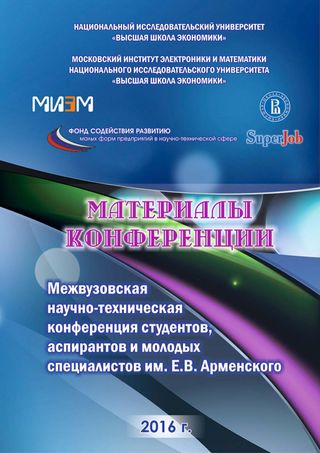
Научно-техническая конференция студентов, аспирантов и молодых специалистов НИУ ВШЭ им. Е.В. Арменского. Материалы конференции
М.: МИЭМ НИУ ВШЭ, 2016.
Similar publications
A polynomial-time algorithm for computing a Pareto optimal and almost proportional allocation
Moulin H., Aziz H., Sandomirskiy F., Operations Research Letters 2020 Vol. 48 No. 5 P. 573–578
We consider fair allocation of indivisible items under additive utilities. We show that there exists a strongly polynomial-time algorithm that always computes an allocation satisfying Pareto optimality and proportionality up to one item even if the utilities are mixed and the agents have asymmetric weights. The result does not hold if either of Pareto optimality ...
Added: August 25, 2020
The Unreasonable Fairness of Maximum Nash Welfare
Moulin H., Caragiannis I., Kurokawa D. et al., ACM Transactions on Economics and Computation 2018
The maximum Nash welfare (MNW) solution — which selects an allocation that maximizes the product of utilities — is known to provide outstanding fairness guarantees when allocating divisible goods. And while it seems to lose its luster when applied to indivisible goods, we show that, in fact, the MNW solution is unexpectedly, strikingly fair even ...
Added: October 19, 2018
Competitive division of a mixed manna
Bogomolnaia A., Sandomirskiy F., Moulin H. et al., / NRU Higher School of Economics. Series EC "Economics". 2017. No. 158.
A mixed manna contains goods (that everyone likes), bads (that everyone dislikes), as well as items that are goods to some agents, but bads or satiated to others. If all items are goods and utility functions are homothetic, concave (and monotone), the Competitive Equilibrium with Equal Incomes maximizes the Nash product of utilities: hence it ...
Added: March 2, 2017
The problem of fair division for a hybrid resource
Blank M., Problems of Information Transmission 2016 Vol. 52 No. 3 P. 299–307
We propose an elementary solution to the apartment rent division problem. This problem belongs to the class of problems of “fair division,” but differs from its standard setting by “heterogeneity,” i.e., the presence of both a conventional continuous component and a discrete one, a fixed set of rooms. A combinatorial-topological approach to solving this problem ...
Added: December 7, 2016
Dividing Goods and Bads Under Additive Utilities
Bogomolnaia A., Moulin H., Sandomirskiy F. et al., / NRU Higher School of Economics. Series EC "Economics". 2016. No. 153.
When utilities are additive, we uncovered in our previous paper (Dividing Goods or Bads Under Additive Utilities) many similarities but also surprising di erences in the behavior of the familiar Competitive rule (with equal incomes), when we divide (private) goods or bads. The rule picks in both cases the critical points of the product of utilities ...
Added: November 14, 2016
Dividing goods and bads under additive utilities
Bogomolnaia A., Moulin H., Sandomirskiy F. et al., / Series arXiv:1610.03745 [cs.GT] "Computer Science". 2016.
When utilities are additive, we uncovered in our previous paper (Bogomolnaia et al. "Dividing Goods or Bads under Additive Utilities") many similarities but also surprising differences in the behavior of the familiar Competitive rule (with equal incomes), when we divide (private) goods or bads. The rule picks in both cases the critical points of the ...
Added: October 13, 2016
The Unreasonable Fairness of Maximum Nash Welfare
Moulin H., Caragiannis I., Kurokawa D. et al., , in: Proceeding of the 17th ACM Conference on Economics and Computation.: [б.и.], 2016.
The maximum Nash welfare (MNW) solution — which selects an allocation that maximizes the product of utilities — is known to provide outstanding fairness guarantees when allocating divisible goods. And while it seems to lose its luster when applied to indivisible goods, we show that, in fact, the MNW solution is unexpectedly, strikingly fair even ...
Added: June 8, 2016
Справедливые дележи с делимыми и неделимыми пунктами
Rubchinskiy A., / NRU Higher School of Economics. Series WP7 "Математические методы анализа решений в экономике, бизнесе и политике". 2009. No. 05.
In the work the fair division problem for two participants in presence of both divisible and indivisible items is considered. The set of all the divisions is formally described; it is demonstrated that fair (in terms of Brams and Taylor) divisions, unlikely the case where all the items are divisible, not always exist. The necessary ...
Added: March 23, 2013
  • About
  • About
  • Key Figures & Facts
  • Sustainability at HSE University
  • Faculties & Departments
  • International Partnerships
  • Faculty & Staff
  • HSE Buildings
  • HSE University for Persons with Disabilities
  • Public Enquiries
  • Studies
  • Admissions
  • Programme Catalogue
  • Undergraduate
  • Graduate
  • Exchange Programmes
  • Summer University
  • Summer Schools
  • Semester in Moscow
  • Business Internship
  • Research
  • International Laboratories
  • Research Centres
  • Research Projects
  • Monitoring Studies
  • Conferences & Seminars
  • Academic Jobs
  • Yasin (April) International Academic Conference on Economic and Social Development
  • Media & Resources
  • Publications by staff
  • HSE Journals
  • Publishing House
  • iq.hse.ru: commentary by HSE experts
  • Library
  • Economic & Social Data Archive
  • Video
  • HSE Repository of Socio-Economic Information
  • HSE1993–2026
  • Contacts
  • Copyright
  • Privacy Policy
  • Site Map
Edit