• A
  • A
  • A
  • АБВ
  • АБВ
  • АБВ
  • A
  • A
  • A
  • A
  • A
Обычная версия сайта
  • RU
  • EN
  • HSE University
  • Publications
  • Book chapter
  • The Problem of Constructing Time Series of Russian Input-Output Accounts for Use in International Projects
  • RU
  • EN
Расширенный поиск
Высшая школа экономики
Национальный исследовательский университет
Priority areas
  • business informatics
  • economics
  • engineering science
  • humanitarian
  • IT and mathematics
  • law
  • management
  • mathematics
  • sociology
  • state and public administration
by year
  • 2027
  • 2026
  • 2025
  • 2024
  • 2023
  • 2022
  • 2021
  • 2020
  • 2019
  • 2018
  • 2017
  • 2016
  • 2015
  • 2014
  • 2013
  • 2012
  • 2011
  • 2010
  • 2009
  • 2008
  • 2007
  • 2006
  • 2005
  • 2004
  • 2003
  • 2002
  • 2001
  • 2000
  • 1999
  • 1998
  • 1997
  • 1996
  • 1995
  • 1994
  • 1993
  • 1992
  • 1991
  • 1990
  • 1989
  • 1988
  • 1987
  • 1986
  • 1985
  • 1984
  • 1983
  • 1982
  • 1981
  • 1980
  • 1979
  • 1978
  • 1977
  • 1976
  • 1975
  • 1974
  • 1973
  • 1972
  • 1971
  • 1970
  • 1969
  • 1968
  • 1967
  • 1966
  • 1965
  • 1964
  • 1963
  • 1958
  • More
Subject
News
May 25, 2026
HSE Scientists Train Neural Network to 'Hear' Faults in Electric Motors
Researchers at the AI and Digital Science Institute of the HSE Faculty of Computer Science have developed a new method—the Signature-Guided Data Augmentation (SGDA) framework—that achieves 99% accuracy in motor fault detection and 86% accuracy in fault classification. The application of this approach can reduce industrial equipment repair costs, minimise downtime, and improve production safety. The study results have been published in Engineering Applications of Artificial Intelligence.
May 25, 2026
'The Humanities Serve as a Conscience'
Maria Mizernaia studies Soviet literature and the history of book publishing. In this interview for the HSE Young Scientists project, she discusses plans to publish a novel about besieged Leningrad, AI-provoked reflections on what it means to be human, and how novels can help satisfy our dopamine hunger.
May 25, 2026
Is It Possible to Predict a Citys Life Based on the Shape of Its Neighbourhoods?
Is it possible to predict, based on the configuration of streets and buildings, where a café will open or where traffic congestion will occur? Participants in the Spatial Analysis and Modelling of Urban Processes research and study group use open data and machine learning to identify universal patterns. Alexander Sheludkov and Eduard Somov discuss the purpose of comparing cities, the need for new forms of urban statistics, and how open data is transforming approaches to urban studies.


Have you spotted a typo?
Highlight it, click Ctrl+Enter and send us a message. Thank you for your help!

Publications
  • Books
  • Articles
  • Chapters of books
  • Working papers
  • Report a publication
  • Research at HSE

?

The Problem of Constructing Time Series of Russian Input-Output Accounts for Use in International Projects

P. 456–463.
Baranov E. F., Kim I., Piontkovski D., Staritsyna E. A.

For a country to participate in international projects, such as WORLD KLEMS, it requires at least two conditions:
1. The presence of a dynamic time series of supply and use tables (SUTs) at current and constant prices, for a sufficiently long period of time
2. The comparability of supply and use tables of all countries, which participate in these projects, adhering to methodology of construction, composition of the tables, classifications of commodities and economic activities (industries).
Unfortunately, the Russian statistics currently do not satisfy these conditions. The first Russian SUTs for 2011, built in accordance with international standards, will be published only at the end of 2015 (previously published tables for 1995-2003 were built in the classifications, "inherited" from the Soviet period). The SUTs for 2012, 2013 and subsequent years, will build by extrapolating the cost structure of products and services for 2011.
However, it leaves the open question of extending the time series of these tables for the retrospective period prior to 2011. As international experience shows, this type of calculations predominantly was conducted by research organizations and universities. Given this, the National Research University Higher School of Economics (NRU HSE) has been developing a methodology for constructing retrospective time series of SUTs, in order to experimentally test it, and apply it to the official SUTs for 2011.
As a starting point for the conversion of SUTs from the Soviet classifications into to the NACE rev.1/CPA classifications, we selected 2003 because this was the year that the Russian Federal State Statistics Service (Rosstat) constructed the last SUTs based on the Soviet classifications for 2003. Besides, there are detailed unpublished data based on the Soviet classifications for the use table at purchasers' prices, which also facilitate the conversion of SUTs from the Soviet classifications to the NACE rev.1/CPA, as well as detailed SNA’s measures of production account. To do this conversion, we have developed and applied a two-step procedure using a variation of the GRAS algorithm. Then, on the basis of the converted SUTs for 2003, we have developed a methodology for constructing a time series of SUTs at current prices using modified RAS procedure over forward and backward sweeps across the time series period.
This report presents the main research conducted and further priorities.

Language: English
Keywords: Input-Output Accounts
Publication based on the results of:
Factors of long-term Russian economic development in global context (2016)

In book

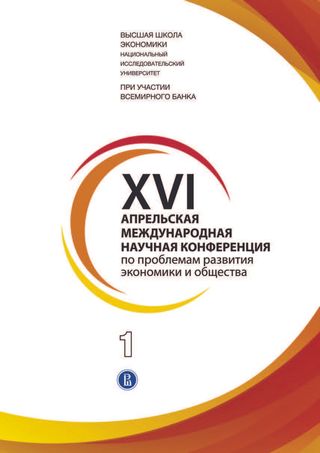
XVI Апрельская международная научная конференция по проблемам развития экономики и общества: в 4 кн.
Кн. 1. , М.: Издательский дом НИУ ВШЭ, 2016.
Similar publications
Constructing Time Series of Russian Input-Output Accounts into NACE/CPA classifications
Baranov E. F., Kim I., Piontkovski D. et al., / NRU Higher School of Economics. Series WP BRP "Economics/EC". 2015. No. 108.
Time series of Input-Output (IO) accounts at current and constant prices are widely applied to study the dynamics and structure of economic activity within country and conduct cross-country comparisons and analyses of globalization processes as well as their impacts. For these purposes IO accounts have to adhere to a uniform nomenclature of products and economic ...
Added: December 3, 2015
Constructing Retrospective Time Series of Russian Input-Output Accounts Based on the NACE/CPA Classifications
Baranov E., Kim I., Piontkovski D. et al., / NRU Higher School of Economics. Series WP BRP "Economics/EC". 2015. No. WP BRP 108/EC/2015.
Time series of Input-Output (IO) accounts at current and constant prices are widely applied to study the dynamics and structure of economic activity within country and conduct cross-country comparisons and analyses of globalization processes as well as their impacts. For these purposes IO accounts have to adhere to a uniform nomenclature of products and economic ...
Added: November 23, 2015
Вопросы построения таблиц "затраты-выпуск" России в международных классификаторах
Baranov E., Kim I., Piontkovski D. et al., Экономический журнал Высшей школы экономики 2014 Т. 18 № 1 С. 7–42
A methodology has been developed to construct a time series of Russian Input-Output (IO) accounts for 2003 and subsequent years. This was based on the OKVED (All-Russian classifier of activities) and OKPD (All-Russian classifier of Products by Activity) classifications that are harmonized with the NACE rev. 1/CPA. The construction used IO Accounts for 2003 ...
Added: April 14, 2014
Методологические проблемы построения систем таблиц "затраты-выпуск" России в классификаторах отраслей и продуктов, соответствующих международным стандартам
Baranov E., Kim I., Piontkovski D. et al., / Высшая школа экономики. Серия WP2 "Количественный анализ в экономике". 2013. № 6.
A methodology has been developed to construct a time series of Input-Output (IO) accounts for 2003 and subsequent years. This was based on the OKVED (All-Russian classifier of activities) and OKPD (All-Russian classifier of Products by Activity) classifications that are harmonized with the NACE rev.1/CPA. The construction used IO Accounts for 2003 built in the Soviet ...
Added: November 18, 2013
  • About
  • About
  • Key Figures & Facts
  • Sustainability at HSE University
  • Faculties & Departments
  • International Partnerships
  • Faculty & Staff
  • HSE Buildings
  • HSE University for Persons with Disabilities
  • Public Enquiries
  • Studies
  • Admissions
  • Programme Catalogue
  • Undergraduate
  • Graduate
  • Exchange Programmes
  • Summer University
  • Summer Schools
  • Semester in Moscow
  • Business Internship
  • Research
  • International Laboratories
  • Research Centres
  • Research Projects
  • Monitoring Studies
  • Conferences & Seminars
  • Academic Jobs
  • Yasin (April) International Academic Conference on Economic and Social Development
  • Media & Resources
  • Publications by staff
  • HSE Journals
  • Publishing House
  • iq.hse.ru: commentary by HSE experts
  • Library
  • Economic & Social Data Archive
  • Video
  • HSE Repository of Socio-Economic Information
  • HSE1993–2026
  • Contacts
  • Copyright
  • Privacy Policy
  • Site Map
Edit