• A
  • A
  • A
  • АБВ
  • АБВ
  • АБВ
  • A
  • A
  • A
  • A
  • A
Обычная версия сайта
  • RU
  • EN
  • HSE University
  • Publications
  • Book chapter
  • Russian Germans as an ethno-linguistic community: Historical development and current state of the youth age group in Moscow
  • RU
  • EN
Расширенный поиск
Высшая школа экономики
Национальный исследовательский университет
Priority areas
  • business informatics
  • economics
  • engineering science
  • humanitarian
  • IT and mathematics
  • law
  • management
  • mathematics
  • sociology
  • state and public administration
by year
  • 2027
  • 2026
  • 2025
  • 2024
  • 2023
  • 2022
  • 2021
  • 2020
  • 2019
  • 2018
  • 2017
  • 2016
  • 2015
  • 2014
  • 2013
  • 2012
  • 2011
  • 2010
  • 2009
  • 2008
  • 2007
  • 2006
  • 2005
  • 2004
  • 2003
  • 2002
  • 2001
  • 2000
  • 1999
  • 1998
  • 1997
  • 1996
  • 1995
  • 1994
  • 1993
  • 1992
  • 1991
  • 1990
  • 1989
  • 1988
  • 1987
  • 1986
  • 1985
  • 1984
  • 1983
  • 1982
  • 1981
  • 1980
  • 1979
  • 1978
  • 1977
  • 1976
  • 1975
  • 1974
  • 1973
  • 1972
  • 1971
  • 1970
  • 1969
  • 1968
  • 1967
  • 1966
  • 1965
  • 1964
  • 1963
  • 1958
  • More
Subject
News
July 2, 2026
Researchers Discover How Spelling Errors Slow Down Reading in Russian
Psycholinguists from the Centre for Language and Brain at HSE University–St Petersburg have shown that words that are frequently misspelled are processed more slowly by readers, even when presented with the correct spelling. The researchers confirmed this effect for the first time using Russian-language materials and found that response speed is most strongly linked to how confidently individuals can distinguish the correct spelling of a word from an incorrect one. The study has been published in The Mental Lexicon.
July 2, 2026
HSE Develops App for Assessing Phonological Processing in Children
Researchers at the HSE Centre for Language and Brain have developed a new digital tool for assessing children's phonological processing skills—the ZARYA (Sound Analysis of the Russian Language) test battery. It is the first standardised application in Russia designed to provide a fast and reliable assessment of children's ability to distinguish speech sounds, retain them in working memory, and perform phonemic analysis. The app runs on Android tablets and smartphones and is available for download from RuStore. Details of the test validation have been published in the Journal of Speech, Language, and Hearing Research.
July 1, 2026
Scientists Discover Why Europium 'Misbehaves'
Europium is a rare-earth metal responsible for the pure red glow in displays and other luminescent materials. For a long time, however, it refused to emit light when surrounded by certain organic molecules known as acylpyrazolone ligands. Chemists have now uncovered the reason: in europium complexes with these ligands, a 'black window' appears—a charge-transfer state in which the energy absorbed by the ligand is dissipated as heat rather than emitted as light. Understanding this mechanism opens the way to designing more efficient red-emitting materials for displays, fluorescent thermometers, and chemical sensors. The results have been published in Dalton Transactions.


Have you spotted a typo?
Highlight it, click Ctrl+Enter and send us a message. Thank you for your help!

Publications
  • Books
  • Articles
  • Chapters of books
  • Working papers
  • Report a publication
  • Research at HSE

?

Russian Germans as an ethno-linguistic community: Historical development and current state of the youth age group in Moscow

Ch. 8. P. 155–171.
Bergelson M., Daria Ryazantseva

From the end of September 2020 to November 2021, the Year of Germany was held in the Russian Federation. At present, while summing up its results, it seems appropriate to focus this paper on the study of the multifaceted, ethnolinguistic community of Russian Germans, especially its Moscow diaspora. In this study, two key points are considered: a brief survey of the history of representatives of the community to the present day and the empirical part of the study, which includes an analysis of in-depth interviews with respondents who are young Russian Germans under 35 living in Moscow. The main purpose of the work was to determine the state of this ethno-linguistic community today: to consider the problem of self-identification of its members, to trace the level of knowledge of the language of the ancestral homeland and the interest in studying and preserving the cultural heritage of their ancestors. In the course of the study, the analysis of various sources revealed that throughout the history of German presence on the territory of this country, the attitude towards them has repeatedly changed: from positive to hostile, then to more neutral; from praising this community as competent specialists and innovators in many fields of science and art, to persecution and repression during the first half of the twentieth century and refusal to be recognised as a full-fledged community. As a result of these actions on the part of the state, the community of Russian Germans found themselves in a state of identity crisis with the problem of the gradual disappearance of their linguistic and cultural landscape. In turn, interviews compiled on the basis of a form created within the framework of the “Languages of Moscow” project demonstrated that even in Moscow, historically, one of the most important centres of Russian Germans settlement, the state of the community is not quite established, due to the low level of presence of native Moscow Germans. At the same time, there is an opportunity for its development, as many respondents consider it important to pass on their cultural and linguistic heritage to their descendants and develop it on the territory of Russia. So, current work has the potential for further, deeper research of the ethno-linguistic community, in particular with a focus on the diaspora of Russian Germans who emigrated to Germany.

Language: English
DOI
Keywords: ethnolinguistic group
Publication based on the results of:
Discourse Practices across Professional, Cultural, and Social Groups (2022)

In book

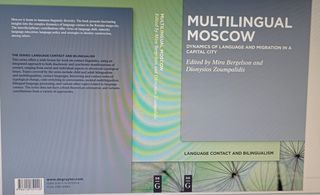
Multilingual Moscow. Dynamics of Language and Migration in a Capital City
Berlin: De Gruyter Mouton, 2024.
Similar publications
Язык и идентичность польской этноязыковой группы в Нижнем Новгороде
Balakina Y. V., Gronskaya N. E., Региональные исследования 2018 Т. 62 № 4 С. 28–35
The following research article is devoted to the problem of self-identification of ethnolinguistic groups in the context of a modern city. The relevance of the present study is determined by the need to identify alternative factors that affect the preservation of the language and identity of small minority groups in modern urbanized environment. Polish ethnolinguistic ...
Added: October 1, 2017
  • About
  • About
  • Key Figures & Facts
  • Sustainability at HSE University
  • Faculties & Departments
  • International Partnerships
  • Faculty & Staff
  • HSE Buildings
  • HSE University for Persons with Disabilities
  • Public Enquiries
  • Studies
  • Admissions
  • Programme Catalogue
  • Undergraduate
  • Graduate
  • Exchange Programmes
  • Summer University
  • Summer Schools
  • Semester in Moscow
  • Business Internship
  • Research
  • International Laboratories
  • Research Centres
  • Research Projects
  • Monitoring Studies
  • Conferences & Seminars
  • Academic Jobs
  • Yasin (April) International Academic Conference on Economic and Social Development
  • Media & Resources
  • Publications by staff
  • HSE Journals
  • Publishing House
  • iq.hse.ru: commentary by HSE experts
  • Library
  • Economic & Social Data Archive
  • Video
  • HSE Repository of Socio-Economic Information
  • HSE1993–2026
  • Contacts
  • Copyright
  • Privacy Policy
  • Site Map
Edit