• A
  • A
  • A
  • АБВ
  • АБВ
  • АБВ
  • A
  • A
  • A
  • A
  • A
Обычная версия сайта
  • RU
  • EN
  • HSE University
  • Publications
  • Book chapter
  • Introduction: W(h)ither Eurasian Regionalization?
  • RU
  • EN
Расширенный поиск
Высшая школа экономики
Национальный исследовательский университет
Priority areas
  • business informatics
  • economics
  • engineering science
  • humanitarian
  • IT and mathematics
  • law
  • management
  • mathematics
  • sociology
  • state and public administration
by year
  • 2027
  • 2026
  • 2025
  • 2024
  • 2023
  • 2022
  • 2021
  • 2020
  • 2019
  • 2018
  • 2017
  • 2016
  • 2015
  • 2014
  • 2013
  • 2012
  • 2011
  • 2010
  • 2009
  • 2008
  • 2007
  • 2006
  • 2005
  • 2004
  • 2003
  • 2002
  • 2001
  • 2000
  • 1999
  • 1998
  • 1997
  • 1996
  • 1995
  • 1994
  • 1993
  • 1992
  • 1991
  • 1990
  • 1989
  • 1988
  • 1987
  • 1986
  • 1985
  • 1984
  • 1983
  • 1982
  • 1981
  • 1980
  • 1979
  • 1978
  • 1977
  • 1976
  • 1975
  • 1974
  • 1973
  • 1972
  • 1971
  • 1970
  • 1969
  • 1968
  • 1967
  • 1966
  • 1965
  • 1964
  • 1963
  • 1958
  • More
Subject
News
July 24, 2026
'Physics Is What the World Is Literally Built On'
Physicist Nina Dzhanayeva, recipient of a Vladimir Potanin Foundation scholarship, focuses her research on nanophotonics. In this interview for the HSE Young Scientists project, she discusses nanowells, scientific intuition, and how physics can help in making frangipane cream puffs.
July 20, 2026
Scientists Create Open Dataset for Studying Concentration
A team of Russian researchers, including scientists from HSE University–St Petersburg, has developed the first open multimodal dataset containing recordings of brain activity, heart function, and video observations to help researchers understand what happens in the human brain during deep concentration. In the future, the dataset could accelerate the development of neural interfaces, rehabilitation technologies, and AI systems. The article has been published in Scientific Data.
July 20, 2026
‘Science Is Universal-It Knows No Borders
Fuad Aleskerov, Tenured Professor and Director of the International Centre of Decision Choice and Analysis at HSE University, together with his colleagues, has developed methods of network analysis in bibliometrics that have made it possible to identify patterns in the appearance and citation of publications in academic journals, as well as their influence on each other. When one or a number of studies are frequently cited by a wide range of journals, this is an indicator that the research is of high quality. By contrast, extensive cross-citation within a limited group of journals increases the likelihood of identifying a network of predatory publications.


Have you spotted a typo?
Highlight it, click Ctrl+Enter and send us a message. Thank you for your help!

Publications
  • Books
  • Articles
  • Chapters of books
  • Working papers
  • Report a publication
  • Research at HSE

?

Introduction: W(h)ither Eurasian Regionalization?

Ch. 1. P. 1–16.
Aseeva A., Górski J.

The three forces that shape the global political economy today are globalization, regionalization, and nationalism. These three forces cannot be assessed in isolation, independently from one another, nor from a perspective of
either law or policy alone. Since the dismantlement of the Soviet Union (USSR), the post-Soviet area became a disputed space where newly created sovereign states, global corporations, foreign interests, old capital and newly-landed oligarchy aligned together either to allow or to resist regional (re)integration. Recent decades have shown advantages and downsides of international trade, a market economy, the developmental rule of law, state ownership of energy companies and general monopoly of the state, and what do those mean for each country in the region. One feature, however, remains intact—undeniable economic and geographical closeness typical for any neighbourliness. The geopolitics and in particular the geoeconomics of the region, existing chains of production and regulatory diversity along with freed market forces have driven most states of the region to look for plural forms of cooperation and exchange while setting apart for a long time (whither forever?) some neighbours.

Language: English
DOI
Keywords: Eurasian geoeconomics

In book

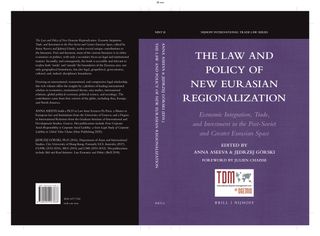
The Law and Policy of New Eurasian Regionalization. Economic Integration, Trade, and Investment in the Post-Soviet and Greater Eurasian Space
Aseeva A., Górski J. Boston: Brill, 2021.
  • About
  • About
  • Key Figures & Facts
  • Sustainability at HSE University
  • Faculties & Departments
  • International Partnerships
  • Faculty & Staff
  • HSE Buildings
  • HSE University for Persons with Disabilities
  • Public Enquiries
  • Studies
  • Admissions
  • Programme Catalogue
  • Undergraduate
  • Graduate
  • Exchange Programmes
  • Summer University
  • Summer Schools
  • Semester in Moscow
  • Business Internship
  • Research
  • International Laboratories
  • Research Centres
  • Research Projects
  • Monitoring Studies
  • Conferences & Seminars
  • Academic Jobs
  • Yasin (April) International Academic Conference on Economic and Social Development
  • Media & Resources
  • Publications by staff
  • HSE Journals
  • Publishing House
  • iq.hse.ru: commentary by HSE experts
  • Library
  • Economic & Social Data Archive
  • Video
  • HSE Repository of Socio-Economic Information
  • HSE1993–2026
  • Contacts
  • Copyright
  • Privacy Policy
  • Site Map
Edit