• A
  • A
  • A
  • АБВ
  • АБВ
  • АБВ
  • A
  • A
  • A
  • A
  • A
Обычная версия сайта
  • RU
  • EN
  • HSE University
  • Publications
  • Book chapter
  • Intelligent Technologies and Systems for Spatial Industrial Strategic Planning
  • RU
  • EN
Расширенный поиск
Высшая школа экономики
Национальный исследовательский университет
Priority areas
  • business informatics
  • economics
  • engineering science
  • humanitarian
  • IT and mathematics
  • law
  • management
  • mathematics
  • sociology
  • state and public administration
by year
  • 2027
  • 2026
  • 2025
  • 2024
  • 2023
  • 2022
  • 2021
  • 2020
  • 2019
  • 2018
  • 2017
  • 2016
  • 2015
  • 2014
  • 2013
  • 2012
  • 2011
  • 2010
  • 2009
  • 2008
  • 2007
  • 2006
  • 2005
  • 2004
  • 2003
  • 2002
  • 2001
  • 2000
  • 1999
  • 1998
  • 1997
  • 1996
  • 1995
  • 1994
  • 1993
  • 1992
  • 1991
  • 1990
  • 1989
  • 1988
  • 1987
  • 1986
  • 1985
  • 1984
  • 1983
  • 1982
  • 1981
  • 1980
  • 1979
  • 1978
  • 1977
  • 1976
  • 1975
  • 1974
  • 1973
  • 1972
  • 1971
  • 1970
  • 1969
  • 1968
  • 1967
  • 1966
  • 1965
  • 1964
  • 1963
  • 1958
  • More
Subject
News
August 13, 2026
‘Working with AI Solves a Wide Range of Engineering Problems
Artificial intelligence is a working tool based on a balanced combination of algorithms and engineering. Experts and doctoral students from the HSE Moscow Institute of Electronics and Mathematics explain how AI technologies can improve an application, device, or system, and what engineering tasks are solved in the process.
August 12, 2026
‘I Would Like My Research to Help Make the World a Calmer and Better Place
Whatever task Saraa Ali, Junior Research Fellow at the Laboratory of Methods for Big Data Analysis (LAMBDA) of the AI and Digital Science Institute (HSE Faculty of Computer Science), is working on, she thinks about how it can benefit people. She told the Young Scientists of HSE University project about her large family, diagnosing three-phase motors, and her dream of building a children’s home in her native country.
August 11, 2026
‘The Peak of Stupidity and ‘The Valley of Despair: HSE Economists Propose an Explanation for the Dunning–Kruger Effect
The Dunning–Kruger effect, which describes a sharp surge in self-confidence among beginners followed by an equally rapid decline as they gain experience, can be explained by the nature of the learning process and the acquisition of new knowledge. This conclusion was reached by Andrey Vorchik of the HSE Faculty of Economic Sciences together with independent researcher Murat Mamyshev. They developed a mathematical model of learning and demonstrated how subjective confidence is formed and changes as knowledge accumulates, as well as how teachers can reduce the ‘valley of despair’ experienced by learners.


Have you spotted a typo?
Highlight it, click Ctrl+Enter and send us a message. Thank you for your help!

Publications
  • Books
  • Articles
  • Chapters of books
  • Working papers
  • Report a publication
  • Research at HSE

?

Intelligent Technologies and Systems for Spatial Industrial Strategic Planning

P. 414–422.
Serova E.

Today, the strategic planning of industrial spatial clusters is becoming extremely important when forecasting industrial regional economic development and making management decisions. Frequently, such challenges involve the use of contemporary methodological approaches and system models. Therefore, the role and importance of system models and intelligent information technologies are increasing, particularly in the creating of interdisciplinary databases and forecasting the results of interaction and interference of different elements of economic space. The main advantage of the research studies, which are based on the spatial approach, is its interdisciplinarity and ability to take advantages of systemic approach and synergy effect in the study of issues related to the spatial organization of the economy and management systems. It is theoretical and empirical study in equal measure. The scientific methodology of the research is system approach and comparative analysis, dynamic principle, and comprehensive consideration of the processes of spatial strategic planning and hybrid modeling. This paper deals with the issues of system modeling implementation and how system models can be used to support the process of spatial industrial strategic planning (SISP) in the context of theory of regional economic growth and development. The main goal of this paper is the analysis of the main domains or areas of system models application to support the process of spatial industrial strategic planning.
Language: English
Full text
DOI
Text on another site
Keywords: Spatial Industrial Strategic PlanningRegional EconomicsHybrid Intelligent Models

In book

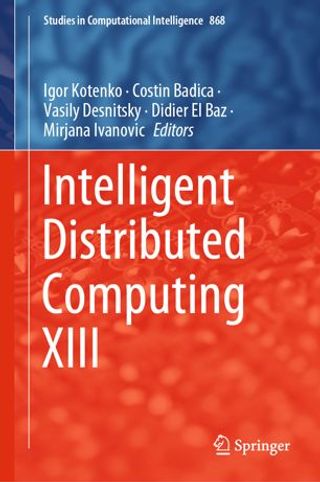
Intelligent Distributed Computing XIII
Switzerland: Springer, 2020.
  • About
  • About
  • Key Figures & Facts
  • Sustainability at HSE University
  • Faculties & Departments
  • International Partnerships
  • Faculty & Staff
  • HSE Buildings
  • HSE University for Persons with Disabilities
  • Public Enquiries
  • Studies
  • Admissions
  • Programme Catalogue
  • Undergraduate
  • Graduate
  • Exchange Programmes
  • Summer University
  • Summer Schools
  • Semester in Moscow
  • Business Internship
  • Research
  • International Laboratories
  • Research Centres
  • Research Projects
  • Monitoring Studies
  • Conferences & Seminars
  • Academic Jobs
  • Yasin (April) International Academic Conference on Economic and Social Development
  • Media & Resources
  • Publications by staff
  • HSE Journals
  • Publishing House
  • iq.hse.ru: commentary by HSE experts
  • Library
  • Economic & Social Data Archive
  • Video
  • HSE Repository of Socio-Economic Information
  • HSE1993–2026
  • Contacts
  • Copyright
  • Privacy Policy
  • Site Map
Edit