• A
  • A
  • A
  • АБВ
  • АБВ
  • АБВ
  • A
  • A
  • A
  • A
  • A
Обычная версия сайта
  • RU
  • EN
  • HSE University
  • Publications
  • Book chapter
  • Observations of Transient Phenomena in BSA Radio Survey at 110 MHz
  • RU
  • EN
Расширенный поиск
Высшая школа экономики
Национальный исследовательский университет
Priority areas
  • business informatics
  • economics
  • engineering science
  • humanitarian
  • IT and mathematics
  • law
  • management
  • mathematics
  • sociology
  • state and public administration
by year
  • 2027
  • 2026
  • 2025
  • 2024
  • 2023
  • 2022
  • 2021
  • 2020
  • 2019
  • 2018
  • 2017
  • 2016
  • 2015
  • 2014
  • 2013
  • 2012
  • 2011
  • 2010
  • 2009
  • 2008
  • 2007
  • 2006
  • 2005
  • 2004
  • 2003
  • 2002
  • 2001
  • 2000
  • 1999
  • 1998
  • 1997
  • 1996
  • 1995
  • 1994
  • 1993
  • 1992
  • 1991
  • 1990
  • 1989
  • 1988
  • 1987
  • 1986
  • 1985
  • 1984
  • 1983
  • 1982
  • 1981
  • 1980
  • 1979
  • 1978
  • 1977
  • 1976
  • 1975
  • 1974
  • 1973
  • 1972
  • 1971
  • 1970
  • 1969
  • 1968
  • 1967
  • 1966
  • 1965
  • 1964
  • 1963
  • 1958
  • More
Subject
News
May 25, 2026
HSE Scientists Train Neural Network to 'Hear' Faults in Electric Motors
Researchers at the AI and Digital Science Institute of the HSE Faculty of Computer Science have developed a new method—the Signature-Guided Data Augmentation (SGDA) framework—that achieves 99% accuracy in motor fault detection and 86% accuracy in fault classification. The application of this approach can reduce industrial equipment repair costs, minimise downtime, and improve production safety. The study results have been published in Engineering Applications of Artificial Intelligence.
May 25, 2026
'The Humanities Serve as a Conscience'
Maria Mizernaia studies Soviet literature and the history of book publishing. In this interview for the HSE Young Scientists project, she discusses plans to publish a novel about besieged Leningrad, AI-provoked reflections on what it means to be human, and how novels can help satisfy our dopamine hunger.
May 25, 2026
Is It Possible to Predict a Citys Life Based on the Shape of Its Neighbourhoods?
Is it possible to predict, based on the configuration of streets and buildings, where a café will open or where traffic congestion will occur? Participants in the Spatial Analysis and Modelling of Urban Processes research and study group use open data and machine learning to identify universal patterns. Alexander Sheludkov and Eduard Somov discuss the purpose of comparing cities, the need for new forms of urban statistics, and how open data is transforming approaches to urban studies.


Have you spotted a typo?
Highlight it, click Ctrl+Enter and send us a message. Thank you for your help!

Publications
  • Books
  • Articles
  • Chapters of books
  • Working papers
  • Report a publication
  • Research at HSE

?

Observations of Transient Phenomena in BSA Radio Survey at 110 MHz

P. 130–141.
Samodurov V., Pozanenko A. S., Rodin A. E., Churakov D., Dumskij Dmitry V., Isaev E., Kazantsev A., Logvinenko S., Oreshko V., Toropov M., Volobueva M.

One of the most sensitive radio telescopes at the frequency of 110 MHz is a Big Scanning Antenna (BSA) in Pushchino Radio Astronomy Observatory of Lebedev Physical Institute (PRAO LPI, Moscow region, Russia). Since 2012 in the BSA the continuous survey observation was started in multibeam mode in the frequency band of 109–112 MHz. Now 96 beams covering from −8 and up to +42° in declination are used. The number of frequency bands are 6 with a time resolution of 0.1 s and 32 bands with the time resolution of 0.0125 s. In a fast mode (32 bands, 0.0125 s) daily data flow is 87.5 GB (32 TB per year). The data provide a great opportunity for both short-term and long-term monitoring of the various radio sources. The sources are fast radio transients of different nature, such as fast radio bursts (FRB), possible counterparts of gamma-ray bursts (GRB), and sources of gravitational waves, the Earth’s ionosphere, interplanetary and interstellar plasma. Based on the BSA observations the database is constructed. We discuss data base prop- erties, the methods of transient search and allocation in database. Using this database we were able to detect 83096 individual transient events in the period of July 2012 – October 2013, which may correspond to pulsars, scintillating sources and fast radio transients. We also present first results and statistics of transients classification. In particular we report parameters of two candidates in new RRAT pulsars.
Language: English
DOI
Text on another site
Keywords: radioastronomypulsarsSurveyFast radio burstsTransients

In book

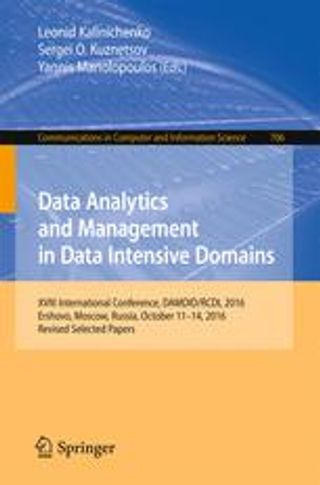
Data Analytics and Management in Data Intensive Domains. XVIII International Conference, DAMDID/RCDL 2016, Ershovo, Moscow, Russia, October 11 -14, 2016, Revised Selected Papers
Cham: Springer, 2017.
Similar publications
Search for Correlations and Study of Selection Effects When Analyzing a Sample of Supernovae Associated with Gamma-Ray Bursts
S. O. Belkin, A. S. Pozanenko, Astronomy Letters 2024 Vol. 50 No. 12 P. 701 – 731
We present the most complete up-to-date sample of supernovae associated with gamma-ray bursts (GRB-SNe) for which the peak time of the SN light curve and the peak absolute magnitude have been found. The sample contains 44 SNe. We have searched for correlations between the parameters of the GRB-SN $$V$$-band brightness peak (the rest-frame $$V$$-band absolute magnitude $$M_{V}$$) and ...
Added: February 20, 2026
Double Plasma Resonance in Electron–Positron Plasma at the Pulsar Magnetosphere
V. E. Shaposhnikov, Simonova T. V., Geomagnetism and Aeronomy 2024 Vol. 64 No. 7 P. 1044–1048
The electron cyclotron waves instability near the frequencies of electron cyclotron harmonics in an electron–positron plasma is studied under conditions typical for the radio emission source with a quasi-harmonic structure of the pulsar in the Crab Nebula. The increment of instability of longitudinal cyclotron waves is calculated for an electron–positron plasma with a small admixture of energetic electrons ...
Added: March 11, 2025
Cross-Correlation Methods in Problem of Search and Identification of Transient Objects in Astronomical Images
E. A. Shekotihin, Pankov N.S., Pozanenko A.S. et al., Pattern Recognition and Image Analysis 2023 Vol. 33 No. 2 P. 157–168
The paper considers the effectiveness of various methods of cross-correlation of astronomical catalogs in solving the problem of search and identification of the sources of rapidly varying brightness, i.e., of the transients. Comparison of the methods is carried out in terms of precision and recall of cross-correlation and is considered by an example of circular fields of the ...
Added: January 30, 2024
Статистика обнаружений импульсных сигналов в площадке со склонениями от +42° до +52° на частоте 111 МГц
Samodurov V., Тюльбашев С. А., Торопов М. О. et al., Астрономический журнал 2022 Т. 99 № 4 С. 334–341
A search for impulse signals was carried out in a new site included in the monitoring program for the search for pulsars and transients. Processing of several months of data recorded in six frequency channels with a total bandwidth of 2.5 MHz showed that, on average, 4 pulses per hour are observed in each of ...
Added: April 23, 2022
XMM-Newton observations of a gamma-ray pulsar J0633+0632: pulsations, cooling and large-scale emission
Даниленко А. А., Карпова А. В., Ofengeim D. et al., Monthly Notices of the Royal Astronomical Society 2020 Vol. 493 No. 2 P. 1874–1887
We report results of XMM-Newton observations of a γ-ray pulsar J0633+0632 and its wind nebula. We reveal, for the first time, pulsations of the pulsar X-ray emission with a single sinusoidal pulse profile and a pulsed fraction of 23 ± 6 per cent in the 0.3-2 keV band. We confirm previous Chandra findings that the ...
Added: November 11, 2020
Origin of quasi-harmonic emission bands with fine structure in the dynamic spectra of high-frequency interpulses of the Crab pulsar
Zheleznyakov V. V., V. E. Shaposhnikov, Monthly Notices of the Royal Astronomical Society 2020 Vol. 495 No. 4 P. 3715–3721
We study the origin of quasi-harmonic emission bands with fine structure observed in the dynamic radiation spectra of high-frequency interpulses. The possible explanation of observed structure is based on the effect of double plasma resonance (DPR) at electron cyclotron harmonics realized in the magnetosphere of pulsar in a local radio emission source filled with non-relativistic plasma. The model of ...
Added: September 10, 2020
Excitation of the main giant pulses from the Crab pulsar
Bespalov P. A., Olga N. Savina, Monthly Notices of the Royal Astronomical Society 2020 Vol. 498 P. 2864–2870
A model for the source of microwave main giant pulses (GPs) from the Crab pulsar is proposed and partly investigated. Pulse excitation takes place in a relativistic pair plasma with a strong magnetic field through the beam pulse amplifier (BPA) mechanism, in which short noise pulses of a certain type are amplified by energetic electrons ...
Added: August 18, 2020
Detectability of neutron star — White dwarf coalescences by eROSITA and ART-XC
Хохрякова А. Д., Popov S., Journal of High Energy Astrophysics 2019 Vol. 24 P. 1–5
Coalescences of neutron stars and white dwarfs are relatively frequent phenomena, outnumbering other types of compact object mergers (neutron stars and black holes without involving white dwarfs) altogether. Such event potentially can produce not only optical, but also an X-ray burst. Transient source CDF-S XT2 (Xue et al., 2019) can be an example of this ...
Added: October 15, 2019
Fast Radio Bursts counterparts in the scenario of supergiant pulses
Popov S., Пширков М. С., Monthly Notices of the Royal Astronomical Society: Letters 2016 Vol. 462 P. L16–L20
We discuss identification of possible counterparts and persistent sources related to Fast Radio Bursts (FRBs) in the framework of the model of supergiant pulses from young neutron stars with large spin-down luminosities. In particular, we demonstrate that at least some of sources of FRBs can be observed as ultraluminous X-ray sources (ULXs). At the moment ...
Added: November 15, 2018
The X-ray properties of Be/X-ray pulsars in quiescence
Wijnands R., Tsygankov S., Degenaar N. et al., Monthly Notices of the Royal Astronomical Society 2017 Vol. 470 No. 1 P. 126–141
Observations of accreting neutron stars (NSs) with strong magnetic fields can be used not only for studying the accretion flow interaction with the NS magnetospheres, but also for understanding the physical processes inside NSs and for estimating their fundamental parameters. Of particular interest are (I) the interaction of a rotating NS (magnetosphere) with the infalling ...
Added: January 16, 2018
NuSTAR discovery of a cyclotron absorption line in the transient X-ray pulsar 2S 1553-542
Lutovinov A., Monthly Notices of the Royal Astronomical Society 2016 Vol. 457 No. 1 P. 258–266
We report the results of a spectral and timing analysis of the poorly studied transient X-ray pulsar 2S 1553-542 using data collected with the NuSTAR and Chandra observatories and the Fermi/GBM instrument during an outburst in 2015. The properties of the source at high energies (>30 keV) are studied for the first time and the ...
Added: January 16, 2018
Perspectives of intellectual processing of large volumes of astronomical data using neural networks
Gorbunov A. A., Isaev E., Samodurov V., Journal of Physics: Conference Series 2018 Vol. 945 No. 1 P. 1–4
In the process of astronomical observations collected vast amounts of data. BSA (Big Scanning Antenna) LPI used in the study of impulse phenomena, daily logs 87.5 GB of data (32 TB per year). These data have important implications for both short-and long-term monitoring of various classes of radio sources (including radio transients of different nature), ...
Added: October 15, 2017
ПРИМЕНЕНИЕ ГЛУБОКИХ НЕЙРОННЫХ СЕТЕЙ ДЛЯ КЛАССИФИКАЦИИ БОЛЬШИХ ОБЪЕМОВ АСТРОНОМИЧЕСКИХ ДАННЫХ
Gorbunov A. A., Isaev E., Samodurov V., Radio Physics and Radio Astronomy 2017 Т. 22 № 4 С. 270–275
In the process of astronomical observations are collected vast amounts of data. BSA (Big Scanning Antenna) LPI used in the study of impulse phenomena, daily logs 87.5 GB of data (32 TB per year). Experts classified 83096 individual observations (on the segment of the study July 2012 - October 2013). Over 75% of the sample ...
Added: October 15, 2017
Поиск источников периодического излучения на радиотелескопе БСА ФИАН
Родин А. Е., Орешко В. В., Samodurov V., Астрономический журнал 2017 Т. 94 № 1 С. 35–43
Описан метод поиска новых периодических источников радиоизлучения, основанный на спектральном анализе, по данным ежедневного мониторинга неба на Большой синфазной антенне (БСА) Пущинской радиоастрономической обсерватории АКЦ ФИАН на частоте 111 МГц. Обсуждаются особенности обнаружения таких источников на БСА. Приводится список обнаруженных периодических источников (всего 16 пульсароподобных источников), их координаты, период и мера дисперсии. ...
Added: March 13, 2017
Круглосуточный радио обзор неба на 110 МГц: база данных наблюдений и статистический анализ импульсных явлений в 2012-2013 гг.
Samodurov V., Pozanenko A. S., Родин А. Е. et al., В кн.: CEUR Workshop Proceedings (Т. 1752, Selected Papers of the XVIII International Conference on Data Analytics and Management in Data Intensive Domains (DAMDID/RCDL 2016) Ershovo, Moscow Region, Russia, October 11-14, 2016)Т. 1752.: Ахен: CEUR-WS.org, 2016. С. 213–218.
В Пущинской радиоастрономической обсерватории АКЦ ФИАН находится один из наиболее чувствительных радиотелескопов на частоте 110 МГц – БСА (Большая Сканирующая Антенна). Начиная с 2012 г. на БСА ФИАН стартовали непрерывные круглосуточные наблюдения на многолучевой диаграмме в полосе 109-112 МГц. Сейчас используются 96 лучей на склонениях от –8 до +42 градуса. Число частотных полос – от ...
Added: January 23, 2017
The daily 110 Mhz radio wave sky survey: statistical analysis of impulse phenomena from observation in 2012-2013
Samodurov V., Dumsky D., Isaev E. et al., Odessa Astronomical Publications 2016 Vol. 29 P. 167–170
On the Pushchino Radio Astronomy Observatory of Lebedev Physical Institute by radio telescope BSA (Big Scanning Antenna) in 2012 started daily multi-beam observations at the frequency range 109- 112 MHz. The number of frequency bands range from 6 to 32, while the time constants range from 0.1 to 0.0125 sec. This data is an enormous ...
Added: December 10, 2016
Эффект двойного плазменного резонанса и его роль в радиоастрономии
Железняков В. В., Злотник Е. Я., Зайцев В. В. et al., Успехи физических наук 2016 Т. 186 № 10 С. 1090–1116
The double plasma resonance effect is a phenomenon in which plasma waves in a magnetized plasma show a sharp increase in instability when the upper hybrid frequency coincides with a cyclotron harmonic frequency. a radiation mechanism associated with this effect provides an explanation of the origin of the "zebra pattern" in radio spectra of the ...
Added: November 18, 2016
  • About
  • About
  • Key Figures & Facts
  • Sustainability at HSE University
  • Faculties & Departments
  • International Partnerships
  • Faculty & Staff
  • HSE Buildings
  • HSE University for Persons with Disabilities
  • Public Enquiries
  • Studies
  • Admissions
  • Programme Catalogue
  • Undergraduate
  • Graduate
  • Exchange Programmes
  • Summer University
  • Summer Schools
  • Semester in Moscow
  • Business Internship
  • Research
  • International Laboratories
  • Research Centres
  • Research Projects
  • Monitoring Studies
  • Conferences & Seminars
  • Academic Jobs
  • Yasin (April) International Academic Conference on Economic and Social Development
  • Media & Resources
  • Publications by staff
  • HSE Journals
  • Publishing House
  • iq.hse.ru: commentary by HSE experts
  • Library
  • Economic & Social Data Archive
  • Video
  • HSE Repository of Socio-Economic Information
  • HSE1993–2026
  • Contacts
  • Copyright
  • Privacy Policy
  • Site Map
Edit